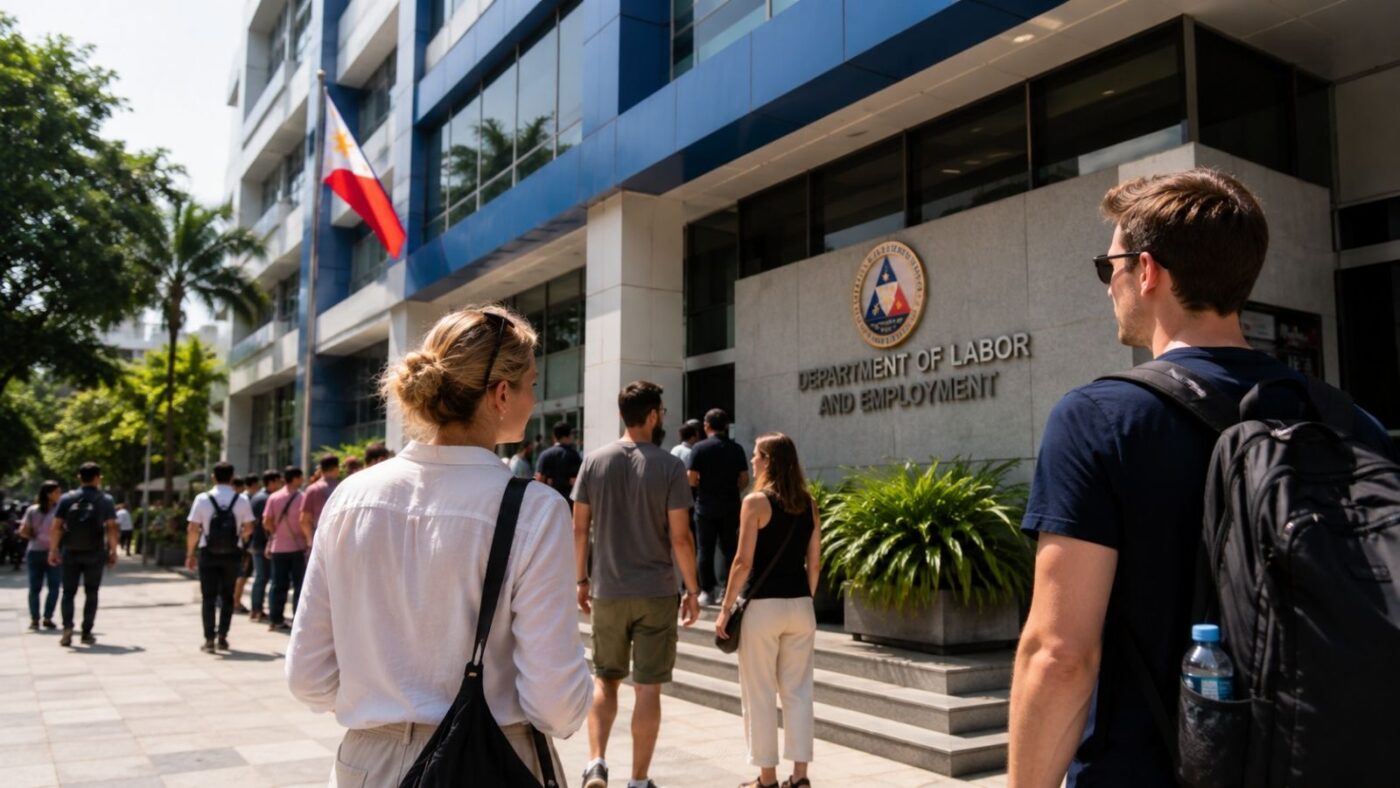
An Alien Employment Permit Philippines application is not proof you got the job. It is proof the government could not find a reason to say no. That distinction is where most delays actually come from.
If you already have an employment contract in hand, the visa is not your first hurdle. The Alien Employment Permit Philippines rules are. The AEP is the labor authorization that decides whether your specific job, for your specific employer, is legally permitted at all, and it is processed entirely separately from your 9(g) work visa. This guide covers the AEP specifically: who needs one, who doesn’t, what it costs, how long it takes, and where applicants most often lose weeks they didn’t need to lose.
For the full picture of how the AEP fits alongside your visa, see our Work Visa Philippines: The Complete Guide to Visas and Permits for Foreign Workers, which covers the whole system; this page goes deep on the AEP alone.
Table of Contents
What Is an Alien Employment Permit Philippines (AEP)?
An Alien Employment Permit is a labor authorization issued by the Department of Labor and Employment (DOLE) under Article 40 of the Labor Code of the Philippines, which requires that no foreign national be admitted for employment without a permit from the Secretary of Labor or an authorized representative. It is not an immigration document and does not grant entry or residence. What it confirms is narrower and more specific: that DOLE has reviewed a particular job, at a particular company, for a particular foreign national, and found no qualified Filipino worker available to fill it. Full current requirements are maintained on DOLE’s regional AEP portal.
The permit is processed at the DOLE Regional Office with jurisdiction over the employer’s principal place of business, not at a single national office. That decentralization matters in practice: two applications with near-identical facts can move at different speeds, or receive different levels of scrutiny under the discretionary Economic Needs Test, depending on which region files them. It is not evidence of favoritism so much as a system built around regional labor market conditions, since a shortage that justifies a foreign hire in one province may not exist in Metro Manila, and vice versa.
Who Needs an AEP?
Any foreign national intending to engage in gainful employment in the Philippines needs an AEP, regardless of contract length, salary source, or seniority. This includes standard 9(g) employees, holders of a Special Investor’s Resident Visa (SIRV) who take on employment, Treaty Trader or Treaty Investor (9(d)) visa holders whose role involves compensation, and executives brought in under company sponsorship. The requirement is tied to the act of working, not to which visa category someone otherwise holds.
This surprises people who assume their visa category already settles the question. It generally does not. A Special Resident Retiree’s Visa (SRRV) grants residence, not employment authorization, so an SRRV holder who takes a job still needs an AEP the same as anyone else. The same logic applies to dependents on a derivative visa: residence status and work authorization are evaluated separately, every time, regardless of what other approval someone is holding.
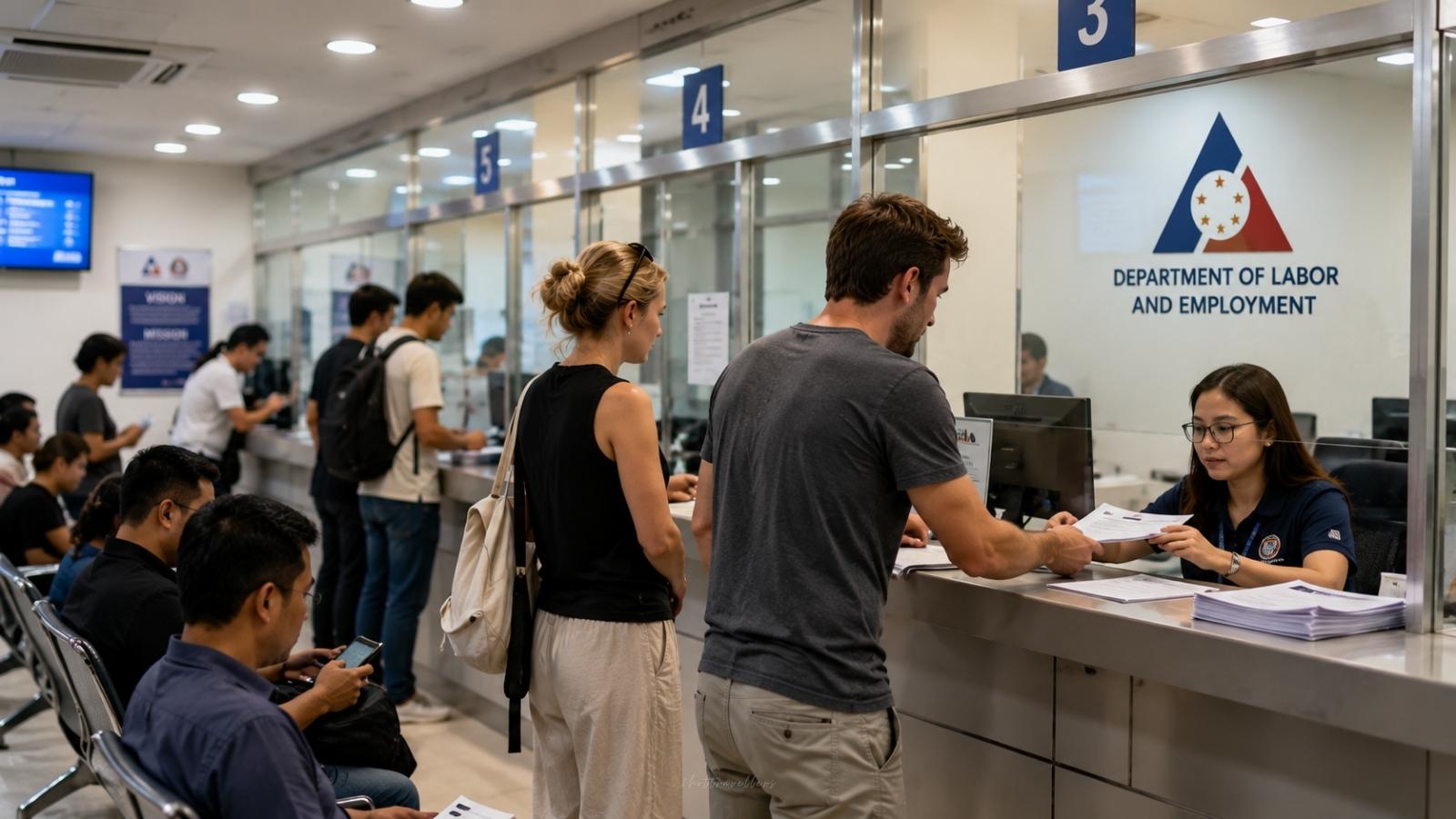
Who Is Exempt?
A defined list of categories is exempt from the AEP requirement altogether, generally because their presence in the Philippines is governed by diplomatic protocol or a separate residence framework rather than an ordinary employment relationship:
- Dependent spouses of accredited diplomatic personnel — covered under diplomatic reciprocity arrangements, not labor law
- Officials of international organizations with diplomatic accreditation — governed by the organization’s host-country agreement
- Embassy and consular staff — same diplomatic basis as above
- Holders of permanent resident visas — already cleared for indefinite stay, separate from employment-based entry
- Recognized refugees and stateless persons — covered under humanitarian protection frameworks rather than standard labor migration rules
AEP vs 9(g) Work Visa: What Each One Actually Does
These two approvals get confused constantly because they’re both required for the same job, filed around the same time, and colloquially both get called “the work visa.” They are not interchangeable, and one does not extend the other.
Labor authorization
Issued by DOLE. Confirms the job itself is permitted and no qualified Filipino worker was available. Governs whether you can legally be employed.
Immigration status
Issued by the Bureau of Immigration. Confirms your right to remain in the country for employment purposes. Governs whether you can legally stay.
A foreign national can hold a fully approved 9(g) visa and still be working illegally if the AEP has lapsed, and can hold a valid AEP while being out of immigration status if the visa side was never converted from tourist. They run on separate clocks, at separate agencies, and neither approval substitutes for the other.
Take a common real-world sequence: an employer secures a foreign hire’s 9(g) visa in three weeks but the AEP, delayed by a Labor Market Test publication error, takes another six. The employee is fully authorized to be in the country. They are not authorized to work in it. That gap is invisible on paper until a BI or DOLE spot-check surfaces it, and by then it is the employer, not just the employee, who is exposed.
Alien Employment Permit Philippines Requirements: What You Need to File
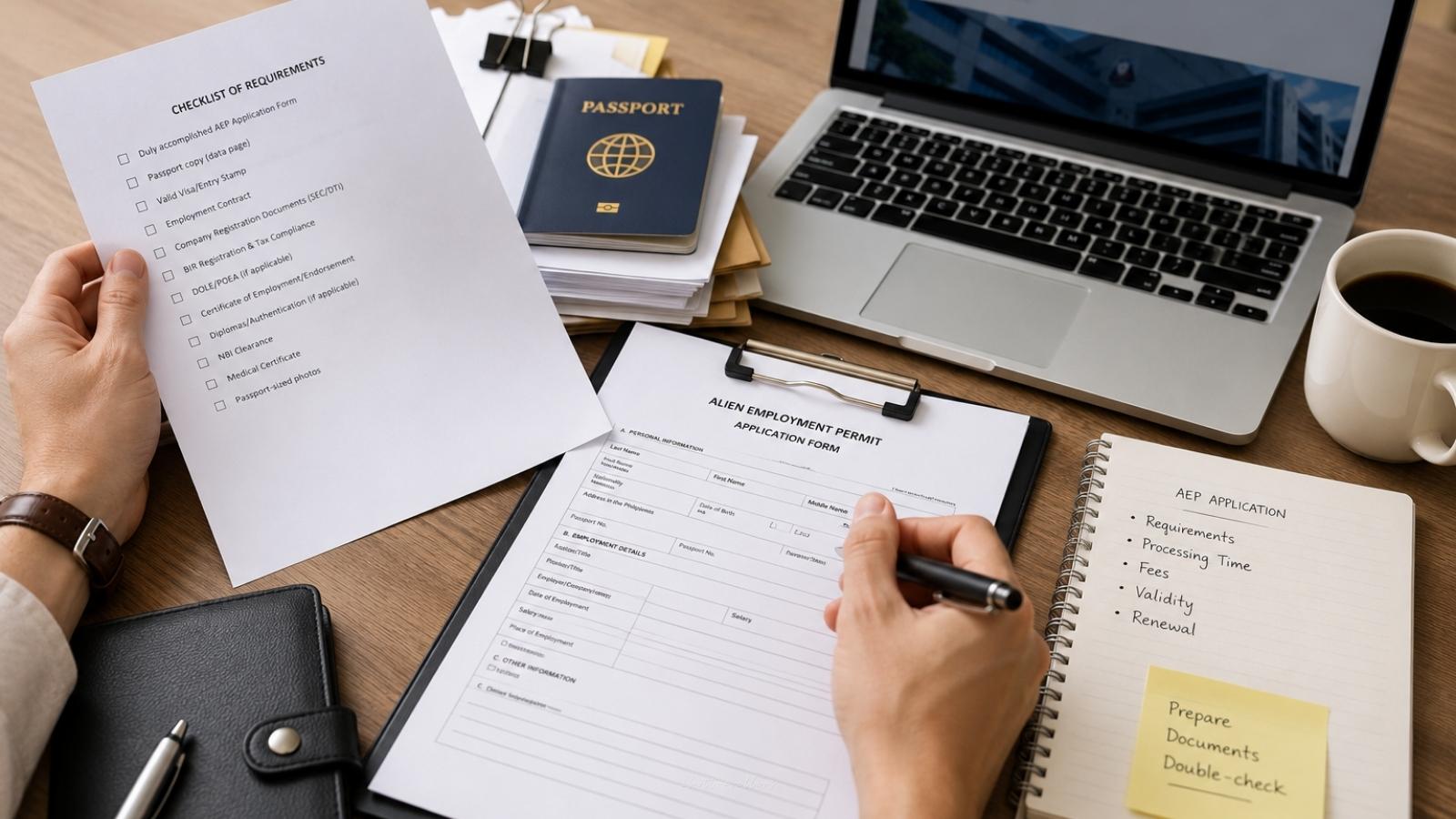
Documentation splits across the employee and the employer, and processing cannot begin until both sides are in order. Missing even one item from the employer’s side, most commonly an expired or not-yet-issued business permit, is enough to stall the entire filing before DOLE even reaches the employee’s paperwork.
Employee side
- Completed AEP application form
- Passport bio-page and latest admission or visa stamp
- Two 2×2 photos taken within the last 6 months
- Notarized employment contract specifying position, salary, duration, and duties
Employer side
- SEC or DTI business registration
- Mayor’s or Barangay business permit
- PEZA or ecozone authority certification, where applicable
- Understudy or Skills Development Program documentation, for incentivized employers
Keep copies of everything submitted, including proof of Labor Market Test publication, well beyond the approval date. Renewal, a future employer change, or a DOLE compliance check can all require producing the original filing again, sometimes years later, and reconstructing it from scratch after the fact is far more time-consuming than filing the original copies away properly the first time.
Step-by-Step AEP Application Process
Business permit confirmed
The employer must already hold its local business permit before AEP processing can begin.
Labor Market Test published
Vacancy posted in a newspaper of general circulation, on PhilJobNet, and with the local Public Employment Service Office, valid for 45 days.
Application filed
Filed at the DOLE Regional Office with jurisdiction over the jobsite, within 15 days of the employment contract’s execution.
Review and issuance
DOLE evaluates the Labor Market Test and, where applicable, the Economic Needs Test before issuing the permit.
The Labor Market Test and Economic Needs Test referenced above came out of a significant 2025 overhaul to the AEP framework. If you want the full breakdown of what changed and why, it’s covered in depth in the work visa Philippines pillar guide. The short version: publication requirements got stricter, and DOLE regional offices now have explicit discretionary authority to deny an AEP even when the vacancy test is technically satisfied.
Processing Time
A complete AEP application typically takes 1 to 3 weeks from submission, not counting the mandatory 45-day publication window and the 15-day filing gap that precede it. Realistically, budget several weeks of total runway between signing an employment contract and having an approved AEP in hand, and treat that estimate as a floor, not a guarantee, since regional DOLE offices are still calibrating how they apply the 2025 rules.
Three factors most often push processing past that floor: an Economic Needs Test review that flags the role for closer scrutiny, an incomplete Understudy or Skills Development Program submission for incentivized employers, and simple regional office backlog, which varies more than most applicants expect between, for instance, Metro Manila and a provincial DOLE office. None of these are things an applicant can accelerate from the outside once filed, which is exactly why front-loading a complete, accurate submission matters more than trying to expedite after the fact.
AEP Fees and Costs
AEP Validity Period
An AEP is currently valid for one year from issuance, or the duration of the employment contract, whichever is shorter. This is a meaningful change from the older framework, still described on many other sites, where permits could be issued for up to five years at once. Under the current rules, longer engagements require annual renewal rather than a single multi-year grant.
The shift matters beyond the paperwork. A five-year permit meant DOLE effectively signed off on a foreign hire once and moved on. A one-year permit, renewed annually, means the justification for that hire, the ongoing Labor Market Test logic and, where applicable, the skills-transfer commitment, gets re-examined every year rather than assumed to still hold. Employers who built hiring plans around the old five-year cycle need to budget renewal as a recurring annual task, not a one-time cost.
Renewing an AEP
Renewal applications must be filed at least 15 days before the current AEP expires. For employers covered by the Understudy or Skills Development Program requirement, renewal now also requires submitting the accomplishment report showing the foreign hire actually trained the required Filipino understudies during the prior permit period, not just that the program was filed. Missing the 15-day window, or arriving at renewal without that documentation, are the two most common causes of a stalled renewal.
In practice, renewal is not a lighter-touch version of the original application. DOLE re-evaluates the position against current conditions each time, which means a role that cleared easily a year ago is not guaranteed to clear again automatically, particularly if the sector-level labor market has shifted or if the Economic Needs Test criteria are applied more strictly at renewal than they were at initial filing. Employers who treat renewal as a formality, submitted at the last possible moment with minimal documentation, are the ones most likely to be caught by a request for additional information they don’t have ready.
☕ If this article saved you a few hours of research, helped answer a lingering question, or made sense of something that wasn't entirely clear before, consider buying me a coffee. It helps keep the guides coming, the curiosity well caffeinated, and the occasional rabbit hole worth exploring.
Buy Me a Coffee ☕Change of Employer
An AEP does not transfer with the employee. It is tied to one specific employer and one specific position, so moving to a new company, even into a near-identical role, requires a brand-new Labor Market Test and a new AEP filed from scratch, not an amendment to the existing permit. This catches out professionals who assume that time already worked in the country, or seniority with a previous employer, carries any procedural weight with a new filing. It doesn’t. Each employer relationship starts the process over.
Consider a marketing director who spends two years with one Philippine-registered company on a fully compliant AEP, then accepts a near-identical role at a competitor. None of that history transfers. The new employer has to run its own Labor Market Test, publish its own vacancy, and file its own AEP as though the applicant had never worked in the Philippines before. The gap between resigning from the old role and receiving the new AEP is the exposure window, and it needs to be planned around explicitly, not assumed away because the person already has a track record in-country.
AEP Cancellation and Revocation
An AEP can be revoked, not just left to expire. Grounds include misrepresentation in the original application, employment that no longer matches the position and duties specified in the permit, and, since the 2025 rule change, failure to implement a required Understudy or Skills Development Program. Employers that continue employing someone after their AEP has been revoked or has lapsed are treated as knowing parties to unauthorized employment, which carries its own administrative exposure separate from whatever happens to the foreign worker’s status.
Revocation is not always triggered by an obvious violation. A role that quietly drifts from what was originally filed, a marketing hire increasingly doing operations work, for example, can be enough to put the permit out of alignment with what DOLE actually approved. Employers restructuring a foreign hire’s responsibilities should treat a significant role change the same way they’d treat a change of employer: as something that may require a fresh filing, not just an internal HR update.
Common AEP Mistakes
Filing after the 15-day window
An AEP application filed more than 15 days after the employment contract’s execution date restarts the entire publication cycle, adding weeks back onto the timeline.
Assuming a 9(g) visa covers the gap
A German engineer’s 9(g) cleared months before his AEP did. He started work anyway, assuming one approval covered both, and the gap became the employer’s problem during a routine BI check.
Treating renewal as automatic
AEP renewal requires active filing 15 days before expiry, plus the training accomplishment report for incentivized employers. Nothing about it happens on its own.
Assuming the AEP transfers with a promotion or transfer
Even an internal transfer to a different role or subsidiary within the same corporate group can require a new AEP, since the permit is tied to the specific position, not the person.
Publishing the Labor Market Test incorrectly
Missing one of the three required channels, newspaper, PhilJobNet, or the local PESO, or omitting a mandated content field, invalidates the publication and restarts the 45-day clock.
Letting a role drift from the filed job description
A position that quietly expands beyond what was approved on the original AEP can put the permit out of alignment with actual duties, and surface as a problem at renewal rather than immediately.
What Employers Are Actually Committing To
Sponsoring an AEP is not a one-time administrative task an HR department files and forgets. It creates an ongoing relationship with DOLE that runs for as long as the foreign employee stays in the role: annual renewal filings, accurate reporting if the position or salary changes, and, for incentivized employers, a live training obligation with periodic progress reports rather than a document filed once and never revisited. Companies that budget for the AEP as a single upfront cost, rather than a recurring compliance responsibility, consistently underestimate what the position actually requires of them a year or two in.
This is worth surfacing before signing an employment contract, not after. A foreign hire who looks straightforward on paper can turn into a multi-year administrative commitment if the employer hasn’t accounted for annual renewal costs, the Understudy Program’s reporting cadence, or the risk that a role change down the line triggers a fresh filing. None of that changes whether the hire is worth making. It does change how realistically a company should plan for it.
Frequently Asked Questions
Is an AEP the same as a work visa?
No. The AEP is a labor authorization from DOLE confirming the job itself is permitted. The work visa, most commonly 9(g), is a separate immigration approval from the Bureau of Immigration confirming your right to stay. Standard employment requires both.
How much does an AEP cost in total?
Typically ₱8,000 for the initial one-year permit, plus ₱3,000 for each additional year or fraction of a year on renewal. Confirm current rates with your DOLE Regional Office before filing, since fee schedules are subject to change.
Can I start working while my AEP is still being processed?
Not on the strength of the AEP application alone. A Provisional Work Permit from the Bureau of Immigration can authorize you to start working while the AEP or 9(g) visa is pending, but it has to be secured separately.
What happens if I change employers?
Your existing AEP does not carry over. A new employer means a new Labor Market Test and a new AEP application filed from the beginning, regardless of how similar the role is.
How long is an AEP valid?
One year from issuance, or the length of the employment contract, whichever is shorter. Older sources describing permits valid for up to five years are referencing a framework DOLE has since replaced.
Am I exempt from needing an AEP?
Only if you fall into a defined exempt category, such as accredited diplomatic staff, international organization officials, or permanent resident visa holders. Even then, you now need to formally secure an AEP Certificate of Exemption rather than relying on the exemption informally.
Can DOLE deny an AEP even if no Filipino applied for the role?
Yes. Since the 2025 rule change, DOLE regional offices have discretionary authority under the Economic Needs Test to deny an AEP on broader national-interest grounds, even when the Labor Market Test itself turned up no qualified Filipino applicant.
Does my AEP cover a promotion or role change with the same employer?
Not automatically. An AEP is tied to a specific position and duties, not just an employer. A significant change in role or responsibilities can require a new filing even without changing companies.
Getting your Alien Employment Permit Philippines application right the first time is the part of this process employers and applicants most often underestimate, because it looks like paperwork rather than a decision. Under the current rules, it is a decision, one DOLE can revisit at renewal, deny outright under the Economic Needs Test, or revoke if the underlying commitments aren’t met. Treating it as a formality is the single most common reason applications that should take weeks end up taking months. The employers and foreign workers who move through it cleanly are usually the ones who filed early, kept documentation complete from the start, and never assumed history with one employer or one role would carry weight with the next.
Once the paperwork side is handled and you’re actually settled in, the country itself is worth exploring beyond the office. If Metro Manila is your base, our Things to Do in Manila: Insider Guide to Attractions, History & Local Realities covers what’s genuinely worth your time versus what’s just there for tourists, and Tagaytay Tourist Spots: The Comprehensive Escape Guide to Crowds & Reality is a solid weekend option once you need a break from the city. Before any of that, though, 7 Philippines Travel Insights Most Travellers Get Wrong is worth a read for the same reason this AEP guide is: the assumptions that work back home rarely transfer cleanly here.