
Ube now appears on menus far from the Philippines, often catching attention before anything else. A purple drink, a slice of cake, something familiar that looks just different enough to stand out. The color makes that possible. It slips easily into formats like lattes and ice cream without asking people to adjust what they already know.
On the surface, it looks like simple growth. Export records show Philippine shipments reaching around 1.7 million kilograms in the most recent period, while domestic production has stayed flat or declined.
The color travels easily. What does not travel as easily are the agricultural conditions, the labor behind traditional preparation, and the role the ingredient once held in Filipino cooking. Those layers remain mostly unseen.
Table of Contents
What the Eye Registers First
The pigmentation that produces consistent violet to lavender tones under artificial lighting and camera sensors functions as a rapid category signal in environments where dozens of options compete for attention within seconds. In saturated visual fields, a natural color that requires minimal additional styling to appear distinctive lowers the barrier to both trial and sharing. The same root that contributes one layer among many in a traditional halo-halo composition becomes the dominant visual element when isolated in a latte, a scoop of ice cream, or a swirl through brioche. This isolation is not accidental. It selects for the attribute most portable across contexts and least dependent on accompanying narrative or new consumer habits.
Mild flavor notes that are earthy, faintly nutty, with a hint of vanilla allow integration into existing dairy and baked templates without forcing changes to sweetness levels or texture expectations. A barista can incorporate ube syrup or powder into a standard latte workflow. A pastry kitchen can fold extract into dough already used for other filled items. The format remains recognizable to the diner. Only the visual marker changes. That combination of low recipe friction and high visual differentiation explains its presence on menus more effectively than positioning around health properties or origin storytelling.
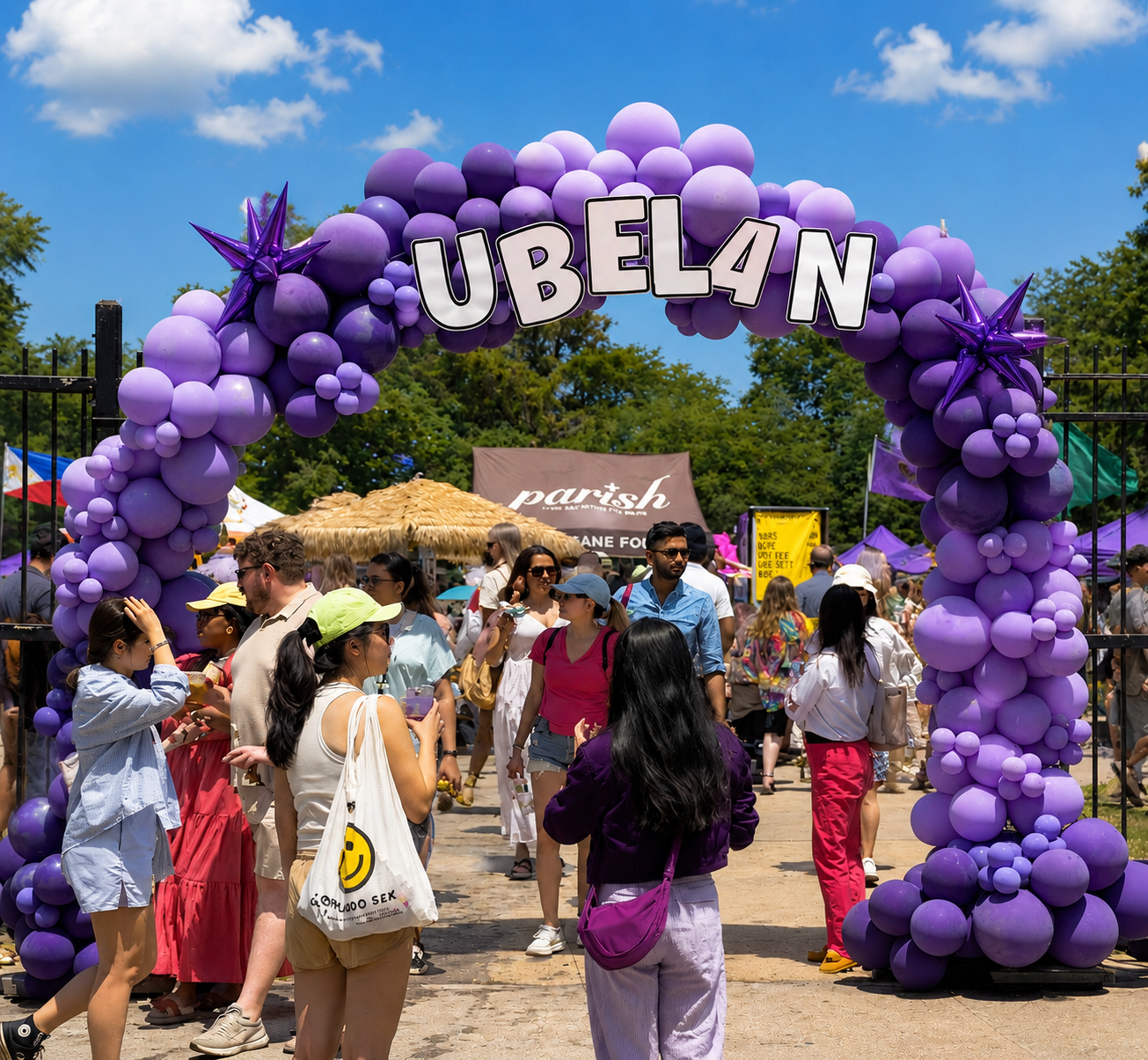
Observation of current menu language shows ube frequently framed as limited, seasonal, or rotating even in markets where Philippine harvest follows a predictable annual cycle tied to regional rainfall patterns. This framing sustains attention through periodic scarcity rather than continuous presence. The color performs the primary work of differentiation.
Menu language and limited-time positioning maintain interest across repeat visits. What remains less visible is how closely this framing aligns with the actual agricultural calendar in the ingredient’s primary production regions.
In environments shaped by high visual throughput, the photograph often comes before the experience. Diners capture the color before tasting because the image itself carries value on platforms that reward immediate recognition. This sequence reinforces the selection of ingredients whose primary distinction can be understood in a single frame without added explanation. Ube meets that condition more efficiently than
The Agricultural Base That Remains Fixed
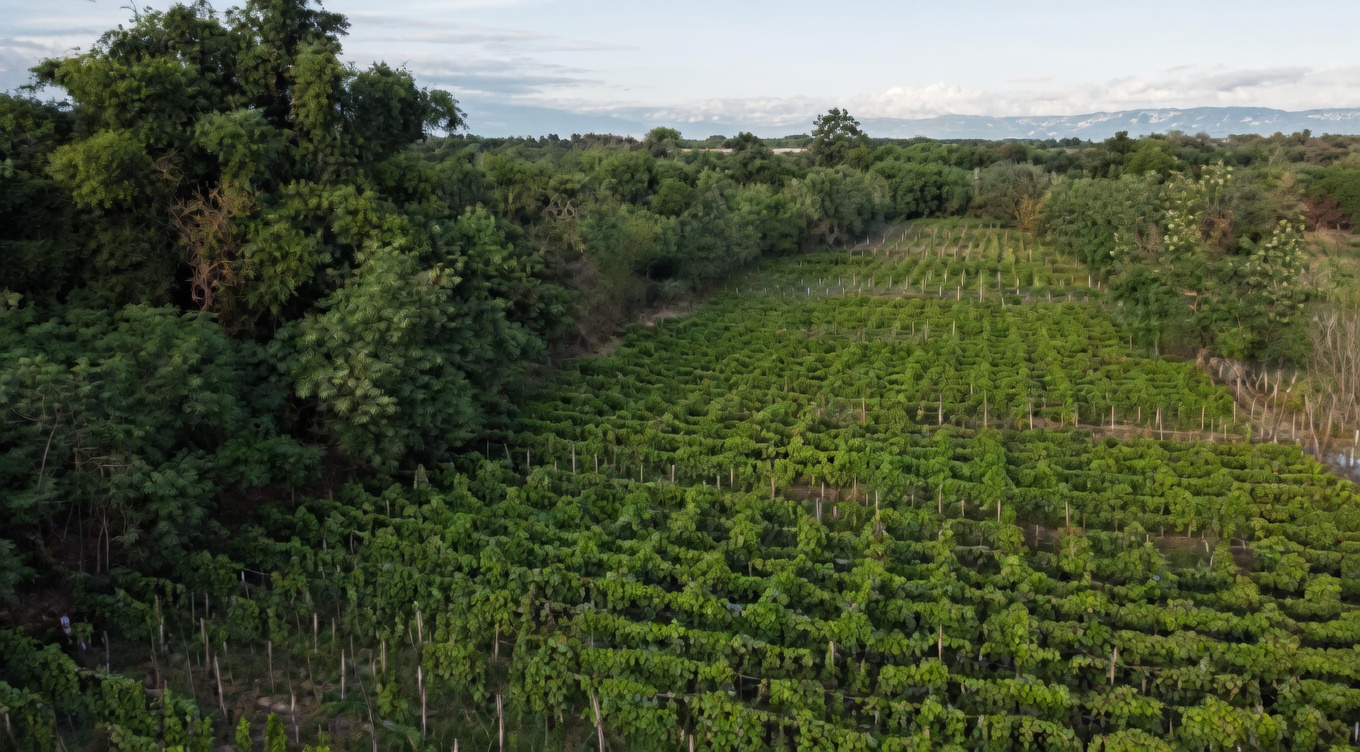
Ube does not scale easily. Its cultivation stays tied to small plots, often intercropped or rotated within diversified smallholder systems rather than expanded into large monoculture blocks. The growth cycle from planting to harvest takes ten to eleven months and depends on consistent moisture during key stages. Production clusters in regions such as Central Visayas, where seasonal rainfall and frequent typhoon exposure directly affect yield stability and post-harvest handling. In recent seasons, more than twenty named storms have affected the archipelago within a single year, disrupting crops and compressing harvest windows.
Propagation relies on vegetative methods. Farmers set aside portions of each harvest as planting material for the next cycle. When prices rise due to external demand, more of the harvest is sold and less is reserved. The next season begins with a smaller base. National production has moved down from earlier peaks above 14,000 metric tons, even as exports of processed ube products have increased. The same anthocyanins that produce stable color under varied lighting also depend on specific soil, moisture, and climate conditions. These conditions cannot be reproduced easily in other locations.
Vietnam and China have expanded purple yam cultivation and now supply a share of global demand that exceeds what Philippine smallholder systems can deliver at export scale. This shifts the supply chain without changing the appearance on the plate. Ube becomes more visible while its origin becomes less specific. The color remains consistent. The growing conditions behind it become distributed and harder to trace.
Ube does not scale easily. Its cultivation depends on specific growing conditions and a slow production cycle. Detailed cultivation practices show how tightly yield depends on soil, moisture, and seasonal timing (see official production guide).
Labor and Transformation That Do Not Scale Easily
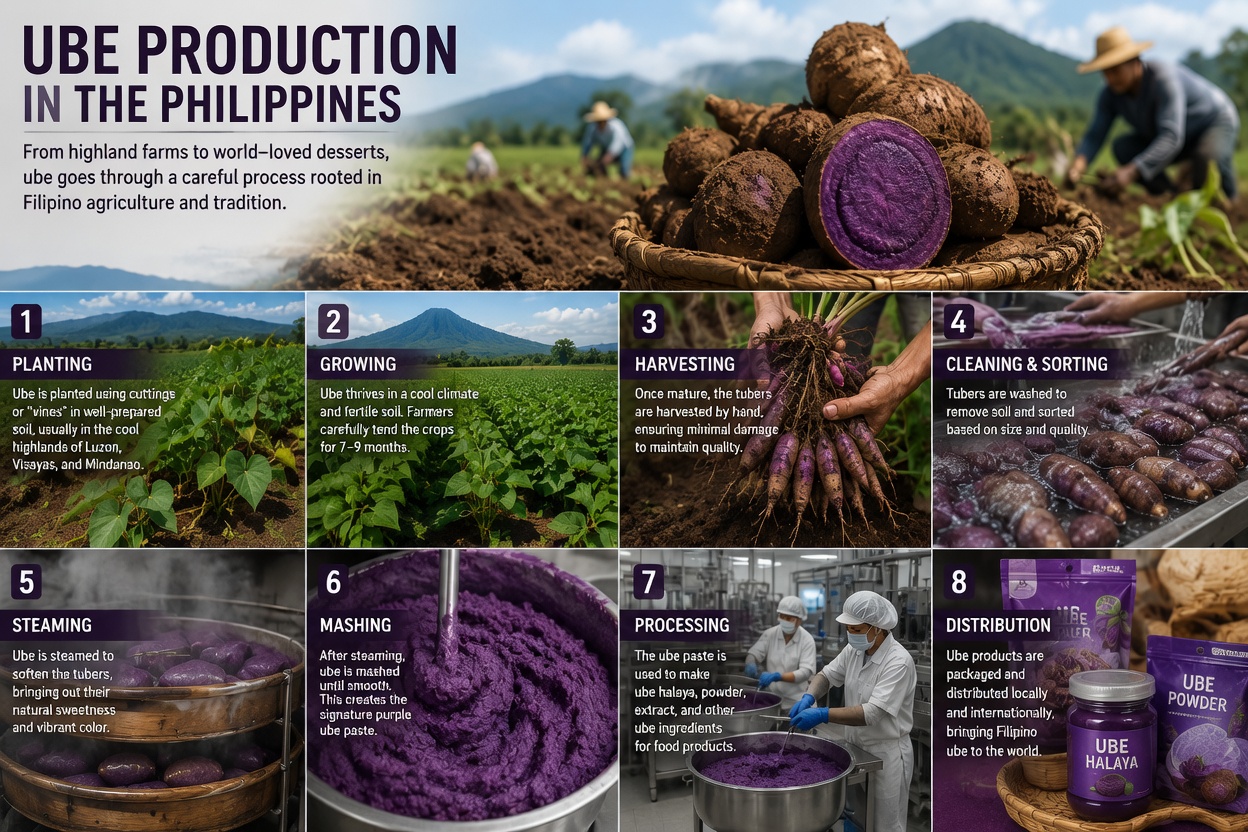
In Philippine households and small-scale kitchens, ube is most often prepared as halaya. The process is direct but time-intensive. The tubers are boiled, peeled, mashed, then stirred continuously with milk and sugar over low heat until the mixture thickens into a smooth paste. Earlier versions used carabao milk. Later adaptations introduced sweetened condensed milk. The stirring can continue for hours. Constant motion prevents burning and allows the starch, pigment, and dairy to bind slowly, developing a deeper, slightly caramelized profile that only forms through sustained heat.
That labor creates a base used across many dishes. It appears as filling in cakes and rolls, as a layer in sapin-sapin or halo-halo, or as part of dense ice cream and porridge. What carries through is not a single flavor but the accumulated texture and structure built during reduction. Halaya is not just a step in preparation. It is the point where the raw tuber becomes stable, usable, and suited to layered desserts in a tropical setting.
The work behind ube is what most people never encounter. What travels is not the process, only the result.
Most global menus do not reproduce this sequence at the same depth. Powder, extract, or pre-made paste replaces freshly reduced halaya. The color remains consistent under display lighting. The behavior changes. Texture, aroma, and interaction with other ingredients shift depending on how the base is produced. Items labeled “ube” often reflect only part of the original transformation.
The difference is not only technical. Slow reduction changes how starch and milk interact, creating a denser structure that holds its shape when portioned. Extract-based versions tend to be lighter and release aroma more quickly when heated. These differences become clear mainly to those who have experienced both forms. For most diners, the distinction never appears because the formats they encounter do not require the full contribution of traditional preparation.
What You’re Missing → Why the Philippines Feels Chaotic to Foreigners: Cultural Patterns Most Travellers Misunderstand
Export Growth Against Domestic Production Trends
Philippine export records show steady expansion in ube products sent to international markets, with the United States taking the largest share and volumes roughly doubling in recent year-on-year comparisons. Total export value exceeded $3.2 million in the most recent period with complete data. At the same time, domestic production has remained flat or moved downward. Most of what is grown still serves local demand, but the gap between total output and export demand has narrowed.
Higher export prices change how growers decide. More of the harvest is sold, and less is kept for replanting. The next cycle begins with reduced planting material. This is not a simple case of rising production meeting new demand. It is a shift within fixed biological and land limits.
Small-scale growers respond to price signals each season. Exporters respond to volume requirements from overseas buyers. The result shows up locally. Whole tubers and traditionally prepared halaya become harder to find at certain times, even as more international menus begin listing ube.
Growth is visible. The base behind it is not expanding in the same way. What looks like expansion is often redistribution.
At points, processors supplement supply by sourcing purple yam from nearby countries to meet export or domestic processing needs. The cycle remains mostly unseen. Local crops move outward. Replacement supply moves inward. The consumer sees only the finished latte, pastry, or packaged mix.
How Formats Shape What Travels
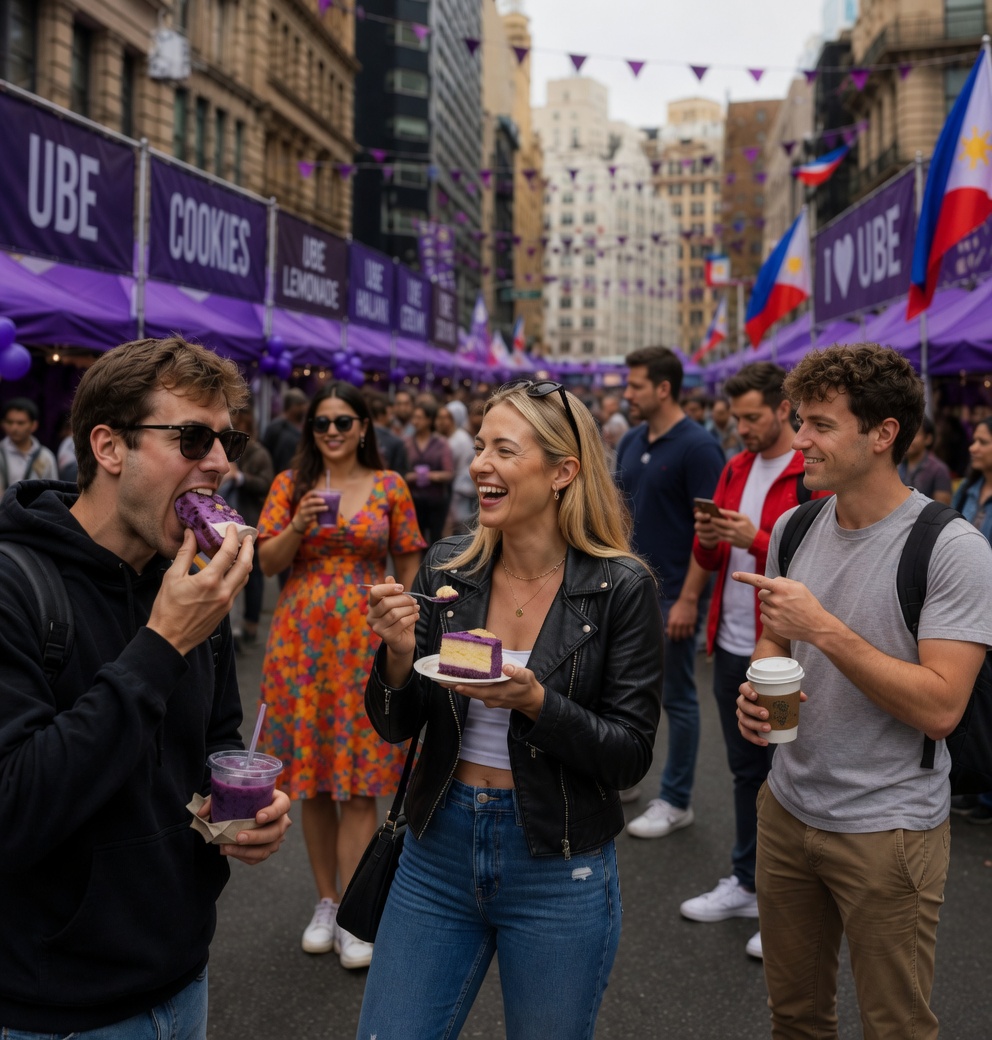
Ube spreads globally through formats that already exist. Lattes, ice cream, pancakes, doughnut fillings, cheesecake bases, and flavored syrups fit easily into established café and bakery systems. These formats require little adjustment and match what people already expect. Simple choices. Familiar structures. No new habits.
In these settings, the color becomes the main signal. In a latte, the purple stands out against milk and espresso. In ice cream, it sits clearly against a neutral base. The format does part of the work. It favors what can be seen quickly and understood without effort. What cannot be isolated is less likely to appear.
Traditional Philippine use follows a different structure. Ube is rarely presented on its own. It is placed within layered dishes where each component has a role shaped by its preparation. Halo-halo combines shaved ice, leche flan, beans, fruit, and halaya in a specific order and proportion. The purple element gains meaning through contrast with other colors and textures.
That structure does not transfer easily. When ube is placed into a single-color drink or pastry, the relationship changes. The format does not just affect how it looks. It determines what people notice. Some qualities become visible. Others fade into the background.
See the Other Side → 7 Philippines Travel Insights Most Travellers Get Wrong
Substitution as a Structural Response
Once recognition attaches to a strong visual trait, pressure builds to keep that appearance consistent at scale. Not every café, bakery, or packaged producer uses fresh tubers or traditionally prepared halaya. Extracts, powders, and in some cases purple sweet potato or taro with added coloring enter the supply chain to meet volume and consistency needs. The color stays within a familiar range. The flavor, texture, and aroma shift depending on how the base is produced.
This pattern is predictable. Visual demand and format compatibility grow faster than any single agricultural system can supply. Substitution follows. It is not mainly about misrepresentation. It is a response to the need for steady output across different locations.
A café in Tokyo or London needs reliable delivery and consistent performance more than strict alignment with origin or traditional process. The menu can still read “ube.” With each layer of processing or substitution, the link to the original growing conditions and preparation methods becomes less clear. The color remains. The context behind it recedes. In many menus, the appearance stays consistent even when the base ingredient changes.
Platform Selection and Visibility Ordering
Social and visual platforms reward what performs well under specific conditions. Phone cameras, indoor lighting, and compressed formats favor high contrast, stable color, and minimal editing. Items that meet these conditions are more likely to be photographed and shared. Ube fits easily into this environment. Its color holds consistently and stands out without extra effort.
These platforms also favor familiar formats. Pancakes, milkshakes, doughnuts, and lattes are easier to recognize than layered desserts. Content that can be understood quickly is more likely to circulate. As a result, ube appears more often in simple, single-item forms rather than in the multi-component dishes where it is traditionally used. Visibility follows what is easy to see and easy to process.
This pattern is not unique to ube. Other ingredients move in similar ways when they carry a strong visual trait. What makes ube different is the structure behind it. It comes from a tightly connected system with small-scale production and labor-intensive preparation. That system does not move as easily as the image.
Platforms do not need to remove this context. They simply favor what travels without explanation. Over time, the visible version of the ingredient becomes narrower than the original. The color remains clear. The conditions behind it become less visible.
Algorithms reinforce this pattern. Images that attract quick attention are shown more often. Bright, single-color items tend to receive faster engagement than layered dishes that take longer to understand. Over time, this shapes what gets produced and shared. The versions that fit these conditions appear more frequently. Those that require more context appear less.
Historical Layering Inside the Ingredient
Ube carries a long history of adaptation within the Philippines. Dioscorea alata has been cultivated for centuries, with evidence reaching back several millennia. Its role in sweets reflects both early use of local starches and later changes introduced through external influence. Spanish methods of preserving fruit and vegetables shaped the development of halaya. The later introduction of sweetened condensed milk during the American period changed sweetness, texture, and shelf life. These shifts influenced how ube could be prepared, stored, and used across different dishes. Ongoing changes in both household and commercial kitchens continue to adapt it to current ingredients and preferences.
Halo-halo reflects this layering clearly. It brings together elements from different origins, including flan, ice cream, beans, fruit, and ube halaya, arranged in a way that remains distinctly local. The meaning of ube in this setting comes from how it sits among other components, not from isolation.
When ube appears in a latte or a packaged mix in another country, the tuber itself is still present. The structure around it is not. The color and mild flavor travel easily. The preparation process, the role within layered dishes, and the conditions of production do not move at the same pace.
What persists is the part that can be separated. What fades is the set of relationships that originally gave it meaning.
Economic Reallocation Patterns
Rising export demand changes how supply is used. It does not operate separately from domestic markets. When prices increase through export channels, growers adjust their decisions. More of the harvest is sold. Less is kept for replanting. The next cycle begins with a smaller base, even if current income improves.
Processors working with overseas buyers need consistent volume. When local supply is not enough, they turn to alternative sources. This changes what enters both export flows and some domestic processing streams. These shifts are structural. They come from limits in biology, land, weather, and the difference between export and local pricing.
The result appears differently depending on where it is observed. International menus continue to expand. At the same time, fresh ube and traditionally prepared halaya can become harder to find in local markets during periods of strong export demand.
Both outcomes come from the same system. Most people only see one side. The expanded menu is visible. The reallocation behind it remains out of view.
There’s More Underneath → Why Travellers Misread the Philippines: The Cultural Patterns Most Visitors Mistake for Chaos
Parallels That Reveal Selection Logic
Matcha offers a useful comparison. Both matcha and ube spread partly because of strong, visible color that performs well on visual platforms. Both move easily into familiar formats such as drinks and desserts that require little adjustment from consumers.
The difference sits in the system behind them. Matcha benefits from large-scale production and established export infrastructure, along with sustained positioning around health. Ube relies more on visual impact within existing formats and does not require much explanation for people to try it.
Quinoa followed a different path. Its global rise was driven by nutritional framing and rebranding, supported by expanded production outside its original region. In each case, a few key traits were selected and scaled, while the full context did not travel at the same speed.
Ube follows a similar pattern. A limited set of attributes moves quickly. Supply chains adjust through geographic expansion and processing changes. What makes ube distinct is the structure it comes from. Production remains small-scale, exposed to seasonal limits, and tied to labor-intensive preparation that does not scale easily.
This comparison is not about ranking outcomes. It shows how selection works. Traits that are easy to see or easy to explain move first. The deeper conditions behind them move more slowly or not at all. When those conditions are closely tied to a specific place, the gap between visibility and understanding tends to widen over time.
What Persists and What Recedes
What remains consistent across contexts is the ingredient itself. The color, the mild flavor, and the ability to blend with dairy and sugar stay recognizable. These are properties of the plant and the techniques built around it.
What becomes less visible is everything that supports it. The labor required to reduce ube into halaya. The seasonal limits on supply. The role it plays within layered dishes. The economic shifts that move it between local use and export demand. These elements do not disappear, but they are less likely to be noticed when the ingredient appears in isolated formats.
Over time, ingredients that spread through a narrow set of strong traits tend to settle into the background. The color remains familiar. It becomes one option among many rather than a point of focus. At this stage, the gap between what is seen and what supports it tends to hold steady, unless there is a clear effort to bring that context forward.
Ube follows this pattern. Its visibility grows through what travels easily. The rest remains present, but largely out of view.

Reading Quiet Ascent as Ongoing Process
The pattern visible on international menus is steady, not sudden. Ube moves into existing slots such as drinks, bakery items, limited offerings, and packaged products because it performs reliably and requires little adjustment. This growth happens alongside pressure on domestic production, not from excess supply. Substitution follows as a practical response to scale and consistency. At the same time, recognition of origin and process remains uneven. Many people encounter ube without connecting it to where it is grown or how it is traditionally prepared.
These patterns are not temporary. The same forces that shaped its spread continue to operate. Agricultural limits, replanting cycles, labor-intensive preparation, platform visibility, and pricing differences between export and local markets all remain in place. They do not pause because the ingredient becomes popular. They continue to shape what appears on menus and what remains less visible.
Most people see only the surface. The visible layer continues to expand, while the underlying system determines how far the ingredient can move and in what form. That system does not disappear. It simply becomes harder to notice.
The surface appearance on menus was never the full account. What is visible reflects only the part that travels easily. Beneath it, the same constraints remain in place. Agricultural limits, labor in preparation, format selection, and shifting supply continue to shape how far the ingredient moves and in what form.
What changes is not the system, but what people notice. The color remains easy to see. The structure behind it becomes less visible over distance. That difference is what defines how the ingredient spreads.



3 Responses
At first, I was super skeptical about eating a tuber/sweet potato for dessert. Purple vegetables belong on a dinner plate, right? But I had a scoop of ube ice cream at a little shop in London, and I am officially hooked. It’s so smooth, earthy, and lightly floral. I’m putting ube on everything now.
I still can’t get over how this is a completely natural vegetable color! 🤯 My Filipina wife brought home an ube cake for my birthday, and the vibrant purple threw me off at first. I was expecting it to taste like artificial blueberry or blackberry, but that subtle, nutty vanilla flavor is totally unique. It’s absolutely brilliant.
The way Filipinos use ube and cheese together is something I never knew I needed. I recently had an ube cheese pandesal and the contrast of the sweet, nutty purple yam filling with the salty, slightly melted cheese is mind-blowing. It’s the ultimate sweet-and-savory comfort food.