
You board the aircraft and everything feels controlled. The smile is consistent. The tone is measured. The service feels effortless. What most passengers don’t realize is that this environment is not natural. It is engineered.
Behind every interaction, flight attendants are running a quiet system of observation, classification, and decision-making in real time. This is where flight attendant secret codes come in. These are not casual phrases or inside jokes. They are a working language built for a high-pressure environment where hundreds of variables must be managed inside a confined space with no margin for error.Table of Contents
The Illusion of Friendliness
Passengers often interpret warmth as connection, but in reality, most interactions inside the cabin are controlled, measured, and deliberately limited. What feels like presence is not the same as closeness. Flight attendants are trained to appear available while maintaining emotional distance, not because they lack sincerity, but because the environment demands it. In a confined space filled with unpredictable behavior, attention has to be regulated, not given freely.
Over time, this creates a subtle but persistent illusion of loneliness. You are surrounded by people, constantly speaking and adjusting, yet rarely engaging in anything that extends beyond the moment. This is where flight attendant secret codes become essential. They operate as a second language beneath the visible script, letting the crew acknowledge reality without disrupting it. What appears to be simple service is also continuous evaluation: who requires attention, who might escalate, who will demand more than they should. Magnify the focal point → What Flight Attendant Uniforms Quietly Reveal About Control, Identity and Cultural Pressure
22 Flight Attendant Secret Codes Behind Those Smiles
Cabin crew do not see passengers as individuals first. They see behavioral archetypes that require specific handling protocols. Several flight attendant secret codes exist purely to label and contain these archetypes.
Codes That Manage Passengers
Assigned to the child whose parents treat the infant as the most important passenger on board. The baby becomes a sacred object the entire cabin must orbit. Parents grow rude to crew while demanding deference from everyone else. The code lets crew coordinate rapid de-escalation without wasting energy on moral outrage.
Also called Jet Bridge Jesus. Describes the elderly passenger who requires wheelchair assistance to board but experiences a sudden recovery upon deplaning. Not cruelty, pattern recognition. The term functions as institutional memory, alerting the next crew that extra caution around mobility claims may be warranted.
A crew member walks past a particularly rude or entitled passenger and releases a silent fart directly in their vicinity. The term turns petty rebellion into operational terminology and reveals how much accumulated resentment must be discharged without breaking the service facade.
VIP means Very Irritating Passenger, the traveler who weaponizes politeness while making endless low-stakes demands. Philip (Passenger I'd Like to Punch) is the aggressive variant, reserved for habitual call-bell abusers. Both flag individuals for calibrated service without verbal escalation.
Identifies the passenger who deliberately spreads across multiple seats to deter others from sitting beside them. Graceful on the surface, territorial underneath. The code enables quicker, less emotional management of the behavior.
Passengers who cluster at the boarding gate like insects, blocking flow and ignoring zone announcements. Captures both the visual and psychological irritation of people who treat boarding as a competitive sport rather than an ordered process.
"Hot coffee in 3B" or naming someone "Bob" (Best on Board or Babe on Board) signals an attractive passenger without alerting the wider cabin. The cheerio game requires a crew member to say the British farewell "cheerio" with a straight face to a passenger they find attractive on disembarkation, while a colleague watches. Basic human attraction, channeled into contained, low-risk expression.
These passenger-management codes share a common function. They convert complex human behavior into actionable categories and reduce emotional load by externalizing judgment. The crew is not being unkind. It is surviving repeated exposure to the same predictable patterns of entitlement, denial, and boundary-testing.
Codes That Protect Cabin Crew Space
The shared apartment or house crew use as a temporary base between flights, often containing dozens of bunks. A pragmatic term: home is wherever the next layover happens to be.
Climbing into a bunk another crew member vacated minutes earlier, sheets still warm. Clinical language that strips away discomfort and turns necessity into routine.
The secret cocktail mixed from onboard ingredients during overnight stays. Not about intoxication. It is rapid decompression after hours of enforced emotional performance.
The crew member who reaches the hotel, slams the door, and doesn't emerge until the next duty period. Not derogatory within the culture. It recognizes a legitimate boundary: some crew need total isolation to reset, and the code protects that choice from social pressure.
A crew member occupying the aircraft's fold-down observer seat rather than working the flight, usually while commuting or repositioning. Distinct from deadheading: the jumpseater remains technically on duty and alert, occupying space that exists for exactly this kind of transit.
The flight attendant who treats the galley as personal domain and discourages uninvited intrusion. Adaptive territoriality: the galley is the crew's only semi-private operational headquarters, and defending it preserves both physical space and mental bandwidth.
Affectionate mockery for crew who genuinely prefer working economy over premium cabins. Reveals an unexpected truth: some crew find more satisfaction in the raw, unfiltered interactions of coach than in the curated expectations of business class.
The blunt internal term for the seatbelt compliance check, crew walking the aisle scanning laps. Strips the task of euphemism and names the awkward intimacy required for safety enforcement.
The final touch-up of makeup or appearance before descent. Recognizes that job performance continues until the last passenger deplanes, even exhausted.
These space-protection codes expose the invisible labor of boundary maintenance. Crew are simultaneously performers and prisoners of the same environment. The language gives them permission to claim small territories of autonomy.
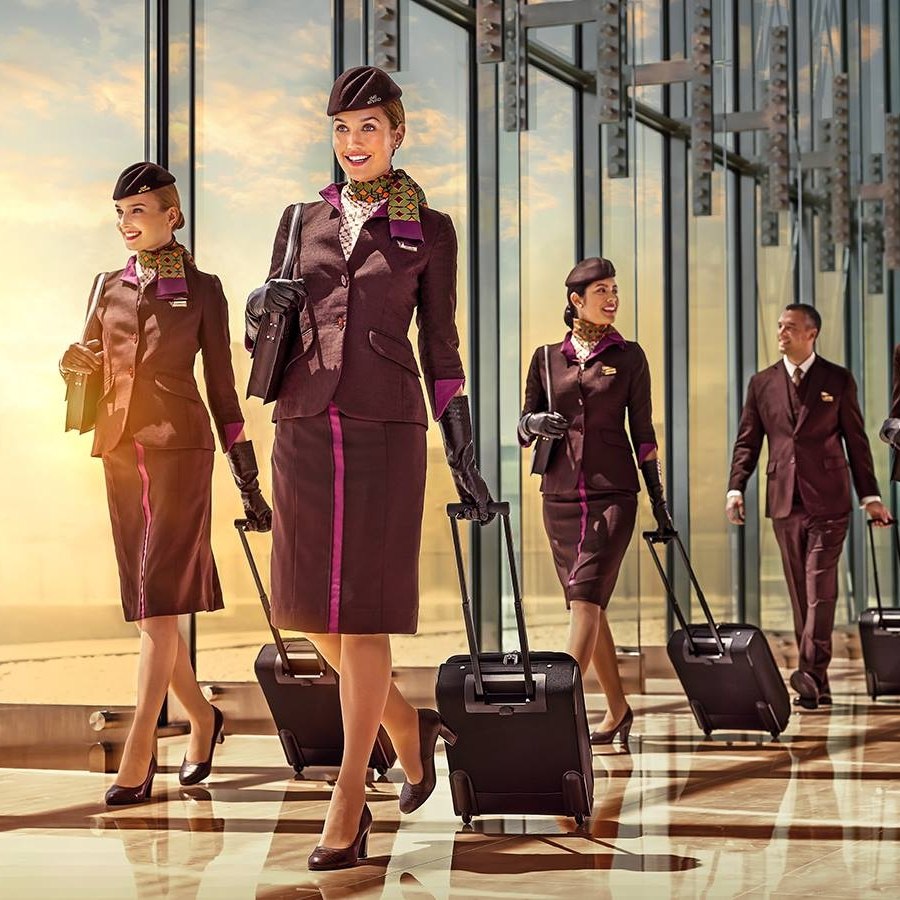
Etihad trains movement to feel effortless. It’s choreography designed to make control feel like comfort.
Codes That Signal Power and Risk
The transponder squawk code signaling a hijacking or security threat. When a pilot quietly "squawks 7500," the aircraft becomes a moving crime scene. Deliberately bland so passengers stay unaware while ground authorities receive an unambiguous alert.
The airport-wide alert for a missing child, named after Adam Walsh. Crew and ground staff use it to trigger immediate, coordinated search protocols without public panic.
The standard verification call confirming emergency doors and slides are properly armed or disarmed. Sounds routine. It is a critical safety redundancy that prevents catastrophic error.
A crew member traveling as a passenger to reposition for the next assignment. Civilian clothes, still bound by duty rules. Highlights the strange liminality of airline labor: both worker and cargo.
Signals a death on board. Gentle language, precise function. It lets crew initiate medical diversion and post-incident procedures while shielding other passengers from immediate knowledge.
Identifies individuals crew mentally flag as potential assistants in an emergency. Turns every passenger into a latent resource rather than a liability.
These power-and-risk codes reveal the rigid hierarchy and contingency planning underpinning the entire operation. The cabin is a controlled environment only because the crew maintains constant situational awareness through coded shorthand. What this reveals → What Flight Attendant Uniforms Quietly Reveal About Control, Identity and Cultural Pressure
What the Codes Reveal About Human Behavior
The most psychologically revealing flight attendant secret codes are those that expose the crew’s own coping mechanisms and the raw humanity that persists beneath the uniform. Cropdusting, landing lips, slam clicker, and crew juice all speak to the same underlying truth: humans in high-performance service roles require outlets for stress, vanity, fatigue, and rebellion. The codes do not judge these needs. They codify them so they can be shared without shame.
The existence of such language demonstrates that emotional labor is not infinite. When crew must suppress irritation, fear, attraction, and exhaustion for hours at a time, the pressure must escape somewhere. Flight attendant secret codes provide the escape valve.bWhat this means → Flight Attendant Life Reality: The Brutal Cost No One Talks About
What the Codes Reveal About Humans in Confinement
Examine the full lexicon and a clear pattern emerges. This is not random slang. It is a sociotechnical system solving three interlocking problems: information asymmetry, emotional labor, and power imbalance.
In confined metal tubes hurtling through the sky, passengers and crew occupy radically different experiential realities. Passengers experience leisure or business travel. Crew experience a high-stakes workplace where every interaction carries safety implications, legal liability, and personal fatigue cost. The codes bridge that asymmetry by letting crew share situational intelligence instantly and privately.
The language also reveals the psychological cost of emotional labor. Sociologist Arlie Hochschild’s concept of the “managed heart” is on full display: crew must produce the correct emotional state on demand while suppressing authentic reactions. The codes function as a parallel emotional economy where genuine feelings can be named, shared, and sometimes discharged safely.
Power dynamics are equally illuminated. The crew holds formal authority for safety while performing subservience for service. The codes let them reclaim narrative control, restoring a sense of agency in an environment where passengers frequently treat them as servants rather than safety professionals. Given any closed system with high repetition and high stakes, people develop private languages to restore predictability, preserve dignity, and maintain sanity. Flight attendant secret codes are a case study in emergent social technology.
Deeper reading on emotional labor → A reconsideration of emotional demands in airline service work
The System Behind the Smile
The next time you board a flight, listen more carefully. The professional smiles remain. The service script continues. But behind the performance runs an entirely different conversation, one that categorizes you, protects the crew, and manages risk with clinical precision. Flight attendant secret codes do not diminish the humanity of the people wearing the uniforms. They prove it.
You will never hear most of these phrases directed at you. That is the point. The system stays invisible so the illusion of effortless flight can hold. Yet once you understand the language, you cannot unsee it. The aircraft is no longer simply a vehicle. It is a floating laboratory of human behavior where a small group of trained observers uses coded speech to maintain order, sanity, and safety.
Sit With This
- If flight attendant secret codes exist to protect crew from passenger behavior, what does that reveal about the actual power dynamic you experience once the cabin door closes?
- How many of your own behaviors in confined public spaces might already have earned you a private label in the crew's coded system?
- When you next encounter polished service on a flight, will the knowledge of the parallel language change how you interpret the interaction?



One Response
I was recommended this website by my cousin I am not sure whether this post is written by him as nobody else know such detailed about my trouble You are amazing Thanks