The Philippines has more than 7,000 islands, and most travel lists treat them as interchangeable. They are not. A rice terrace in the Cordillera and a sandbar off Palawan solve completely different problems for completely different travelers. The country’s real value is in matching the two correctly, not in visiting everything once.
Philippines tourist spots get marketed as one flat category: a scroll of pretty photos with no logic connecting them. That approach wastes a traveler’s most limited resource, which is time on the ground. The problem usually isn’t the destination itself. It’s that most lists never tell readers what kind of place they’re actually walking into. This guide sorts the country’s best-known and most underrated destinations into categories that actually matter when you’re deciding where to go: beaches and islands, mountains and highlands, historical and heritage sites, cities, natural landmarks, and the handful of places most itineraries skip entirely. Each entry includes what the place actually delivers, who it suits, and what tends to disappoint people who go in with the wrong expectations. If you’re building a first-time itinerary or filling gaps in a repeat trip, treat this as a filter, not a checklist.
Table of Contents
How to Use The Philippines Tourist Spots List
See It More Clearly → Best Time to Visit the Philippines
Beach and Island Destinations
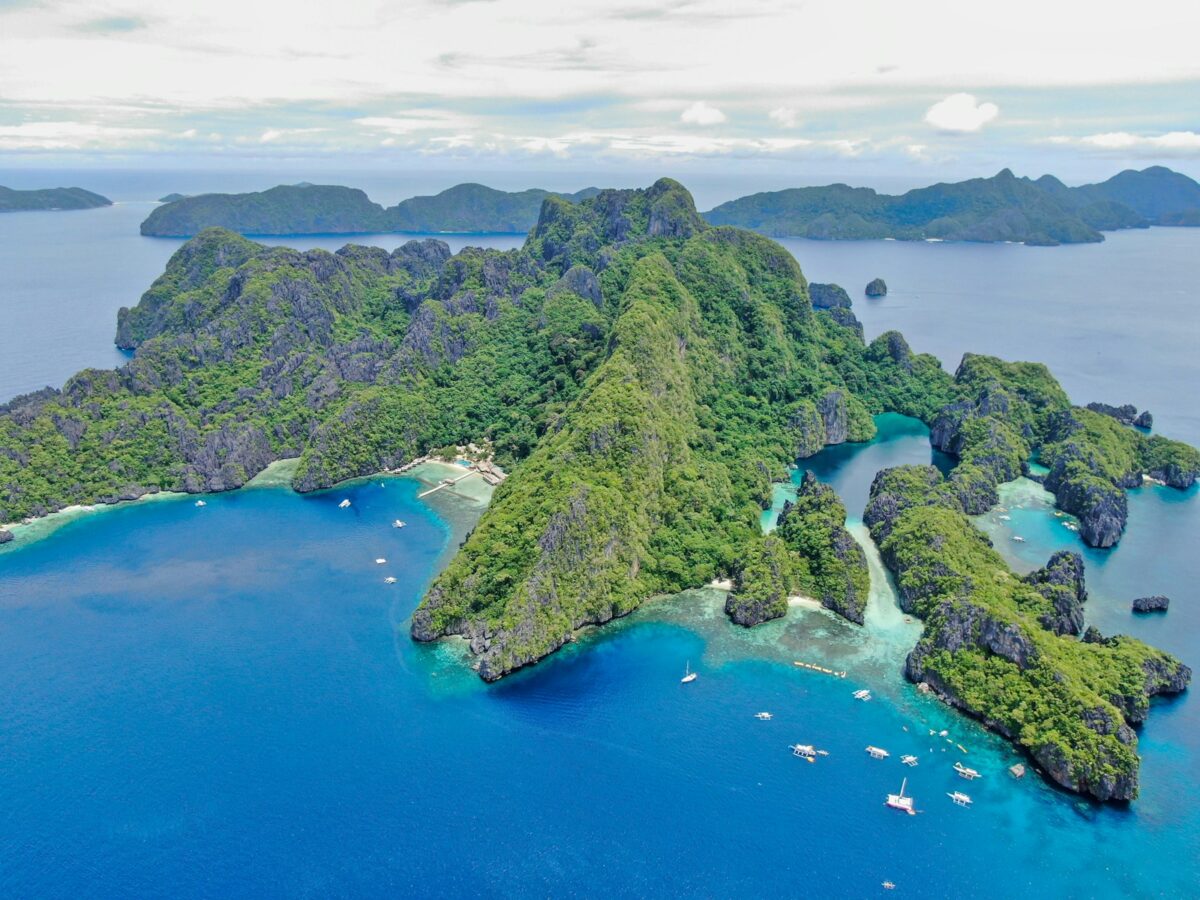
Beaches are the reason most people book a Philippines trip, and they are also where expectations go wrong most often. Not every island delivers postcard water, and the best ones vary enormously in cost, accessibility, and crowd level, which is exactly where Palawan, Boracay, and Siargao end up telling three different stories.
PALAWAN: the Benchmark for a Reason
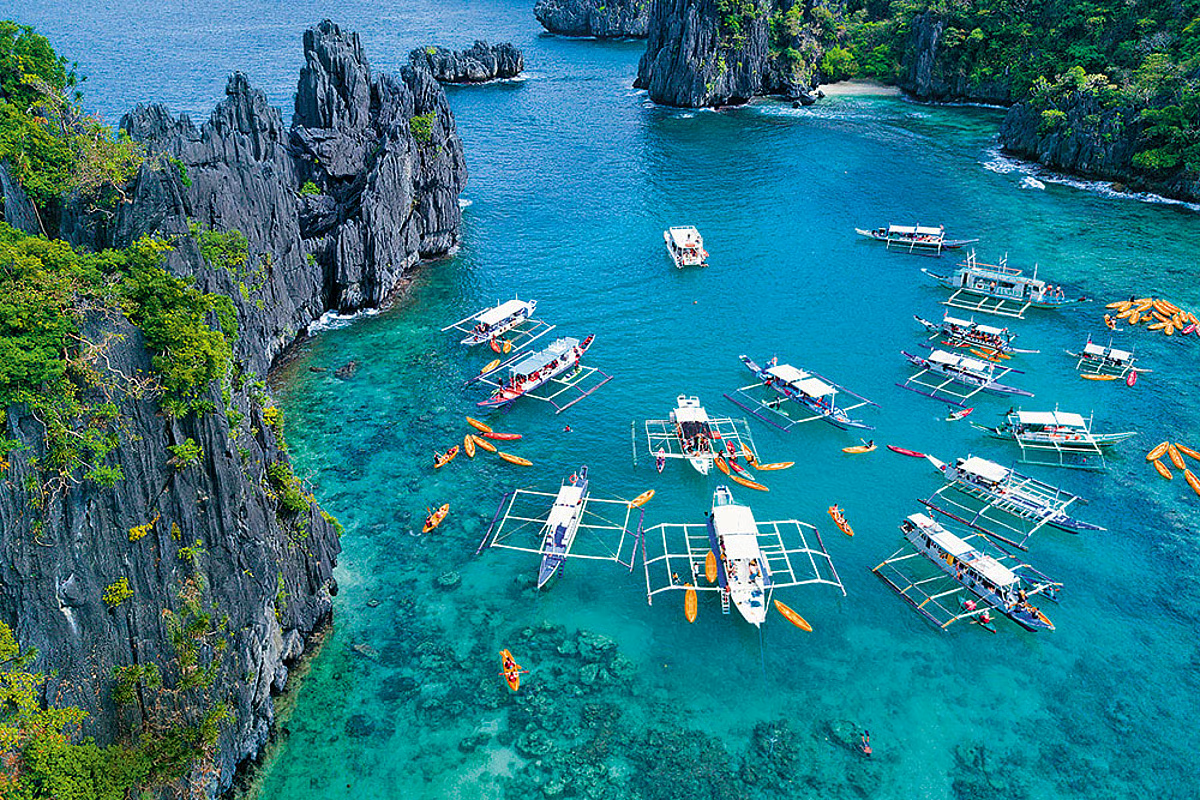
Both towns get genuinely crowded during peak season (December to May), and the island-hopping tours run on fixed group boats with a set itinerary, so travelers who want to swim somewhere alone or set their own pace often find the format restrictive. [LINK: Palawan Travel Guide]
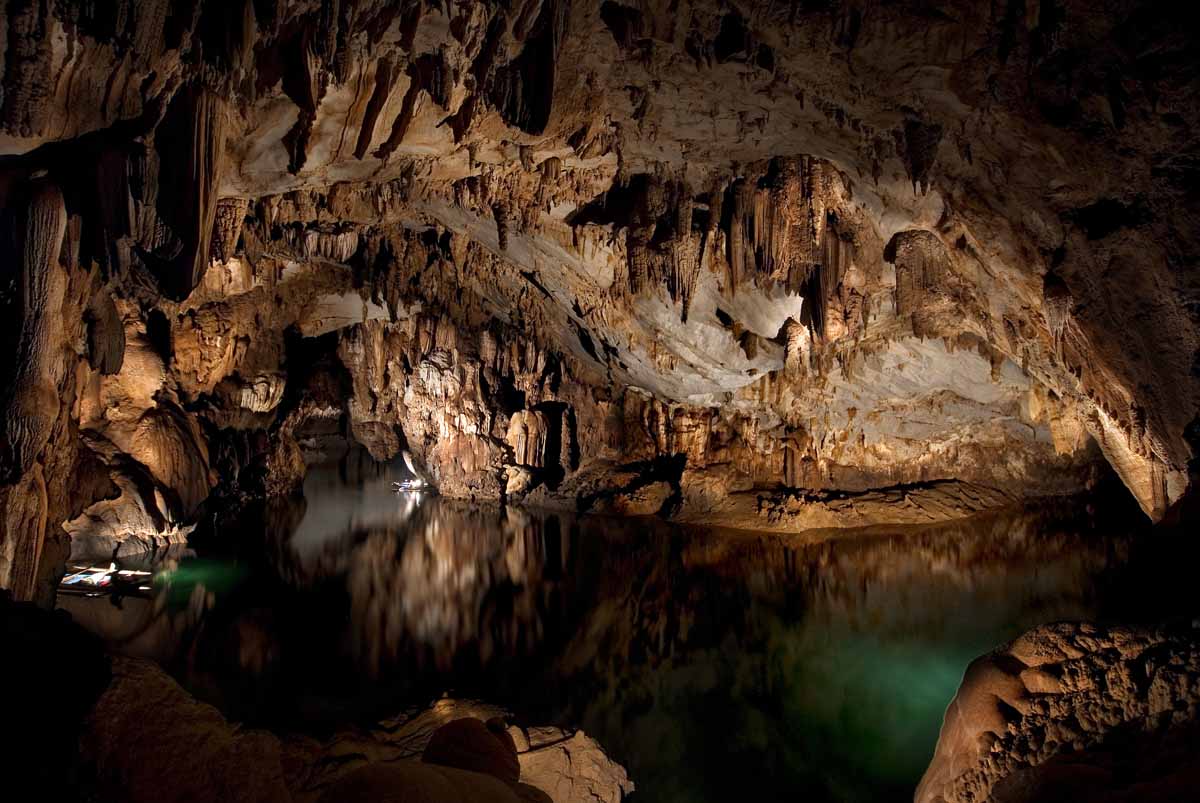
Puerto Princesa is the province’s actual capital, and most travelers treat it as a runway between the airport and El Nido or Coron, which means they miss the one attraction that runs nothing like the island-hopping tours elsewhere in Palawan. The Puerto Princesa Subterranean River, a UNESCO-listed system, operates on timed permits and a fixed paddle route through the cave, not the wander-at-your-own-pace format most beach destinations in this guide offer. Book the slot before you arrive; showing up hoping to walk on is the most common way travelers miss it entirely.
BORACAY: the Resort-Town Blueprint
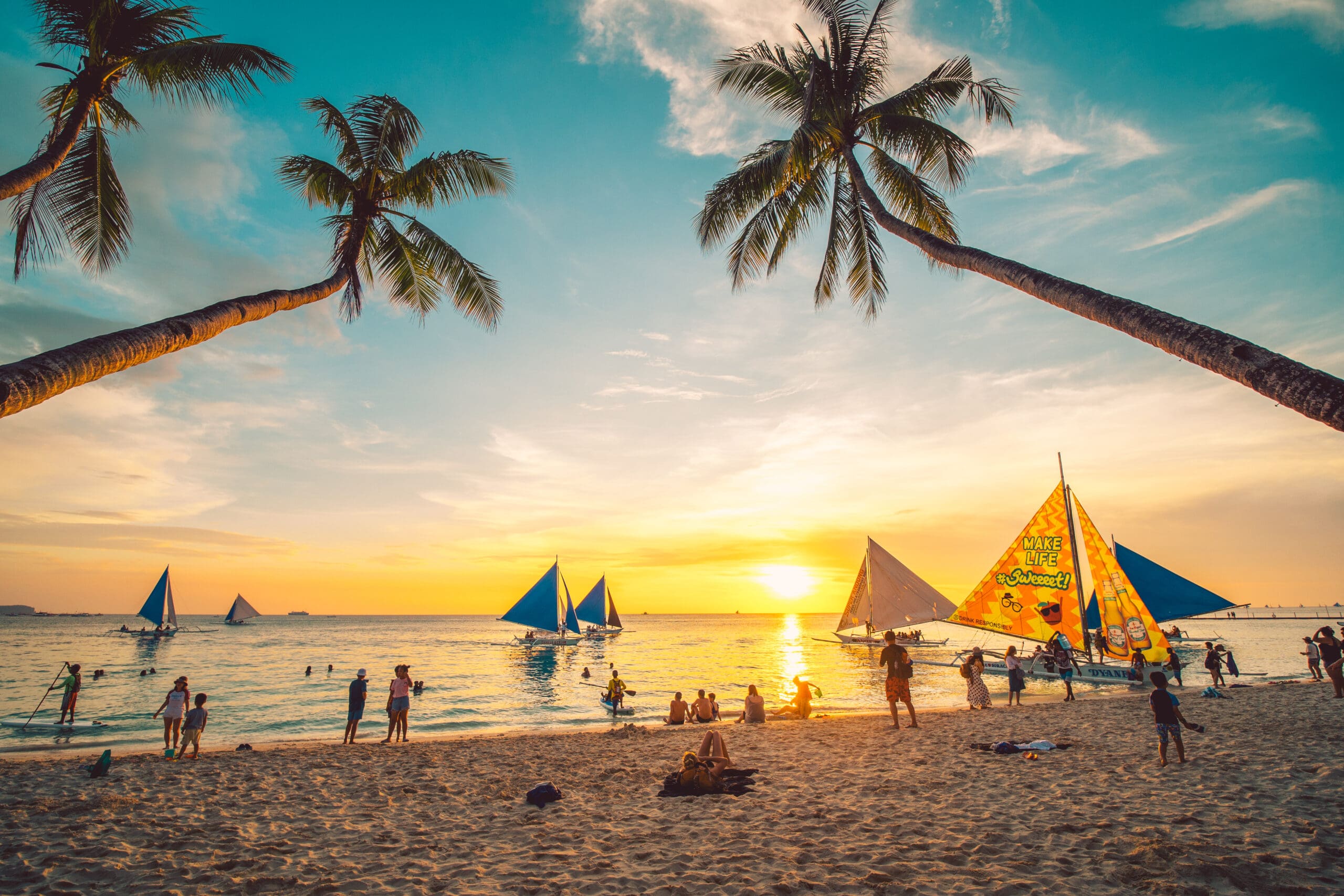
Boracay is the country’s most internationally recognized beach destination, and it earns that recognition through infrastructure rather than seclusion. White Beach delivers four kilometers of genuinely excellent sand, backed by a dense strip of resorts, restaurants, and nightlife. This is the right choice for travelers who want beach access without giving up reliable wifi, varied dining, and an easy airport transfer. It is the wrong choice for anyone chasing an untouched-island feeling; that ship sailed once the government-mandated 2018 rehabilitation reopened the island as a more regulated, but still busy, resort town.
Travelers arriving with the empty-beach photos still circulating from years before the closure tend to find something different: a clean, well-run resort strip that’s genuinely crowded at sunset, when Station 2 fills with people angling for the same shot. Neither disappointing nor magical, just accurately described by almost nothing written about it.
Siargao: the surf island that outgrew surfing
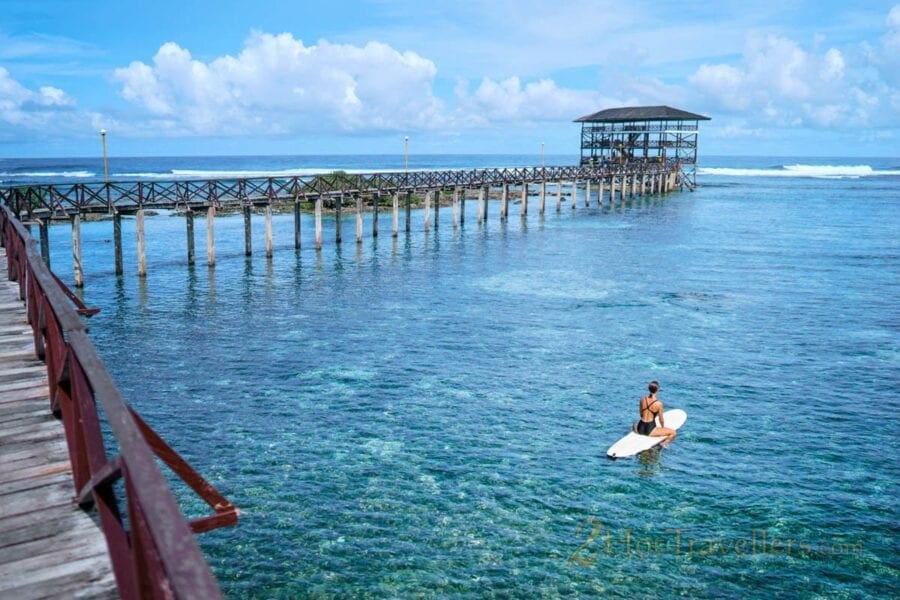
Siargao built its reputation on Cloud 9, a reef break internationally ranked among the country’s best, which put the island on surfing itineraries long before it became a general travel destination.
What’s changed is that Siargao no longer only serves surfers, and that shift shows in the town: General Luna now runs closer to a slow-travel, laptop-friendly beach town than a surf camp, cafes filling with remote workers as much as with people fresh off the water. Travelers expecting Boracay-level resort polish, or expecting a quiet undeveloped island because of how it’s photographed online, tend to be recalibrating within a day or two of arrival; Siargao is developed, just developed around a different crowd.
Rainy season (roughly June to October) also happens to be surf season, so factor that trade-off into timing. Full breakdown in the Siargao Island guide.
Remote and private-island options
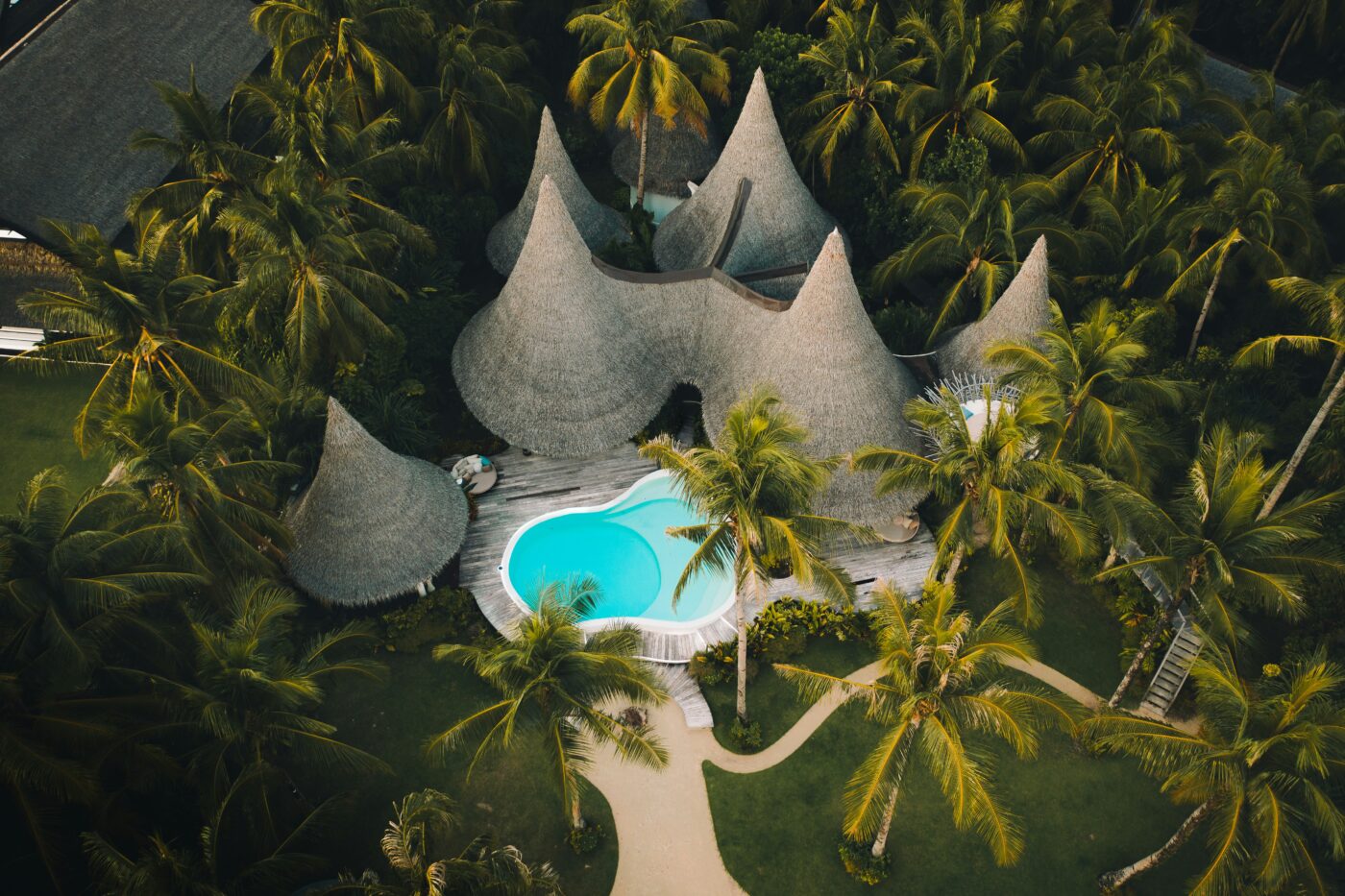
For travelers with a higher budget and a lower tolerance for crowds, a small number of islands operate as fully private, plane-access-only resorts. Amanpulo in northern Palawan and Huma Island near Puerto Princesa both fall into this category: no walk-in access, no nearby town to explore, and a price point that reflects total exclusivity rather than proximity to anything.
What that isolation actually feels like day to day is worth naming honestly: there’s no version of wandering into a local eatery or getting mildly lost, because there’s nowhere to wander to. Some travelers find that restful. Others find it airless by day three. It’s worth being clear with yourself about which kind you are before booking, since these aren’t destinations to combine with a budget backpacking loop; they’re standalone trips built entirely around isolation and service.Underrated beach alternatives
Bantayan Island and Malapascua off northern Cebu, and Samal Island near Davao, deliver a version of the Boracay-style white-sand experience with a fraction of the tourist volume. They stay under-visited mostly because they’re a step removed from a major airport, a ferry connection rather than a direct flight, which is exactly the friction that keeps a place quiet. Expect fewer ATMs, more cash-only transactions, and dive shops or restaurants that close without notice off-season. If your priority is quiet water over convenience, that trade is usually worth making.Historical and Heritage Sites
Vigan: the country's best-preserved Spanish colonial town
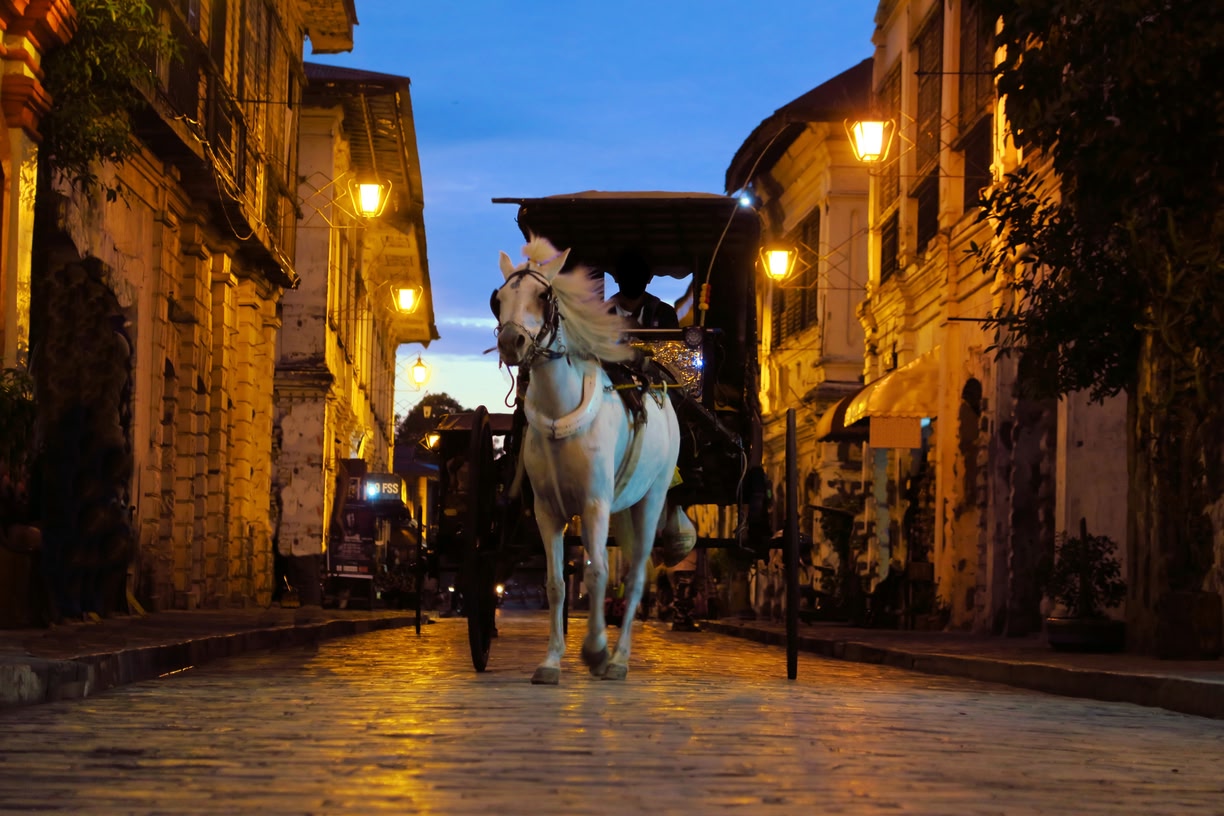
Vigan, in Ilocos Sur, is a UNESCO World Heritage Site and the most intact example of a planned Spanish colonial town left in Asia. [LINK: Vigan Travel Guide] Calle Crisologo, its signature cobblestone street, is vehicle-free and lined with centuries-old heritage homes still in active use, not preserved as a museum piece. This distinction matters: Vigan functions as a living town, which gives it a different texture than a heritage site that exists purely for tourism.
Plan at least a full day, and go early morning or late afternoon to avoid both the heat and the tour-bus crowds that arrive mid-day. The difference between the two isn’t subtle: early morning belongs mostly to locals opening shopfronts and the odd cyclist, while early afternoon turns into a slow-moving crowd of tour groups working through the same photo spots in the same order.
Intramuros, Manila: the walled city
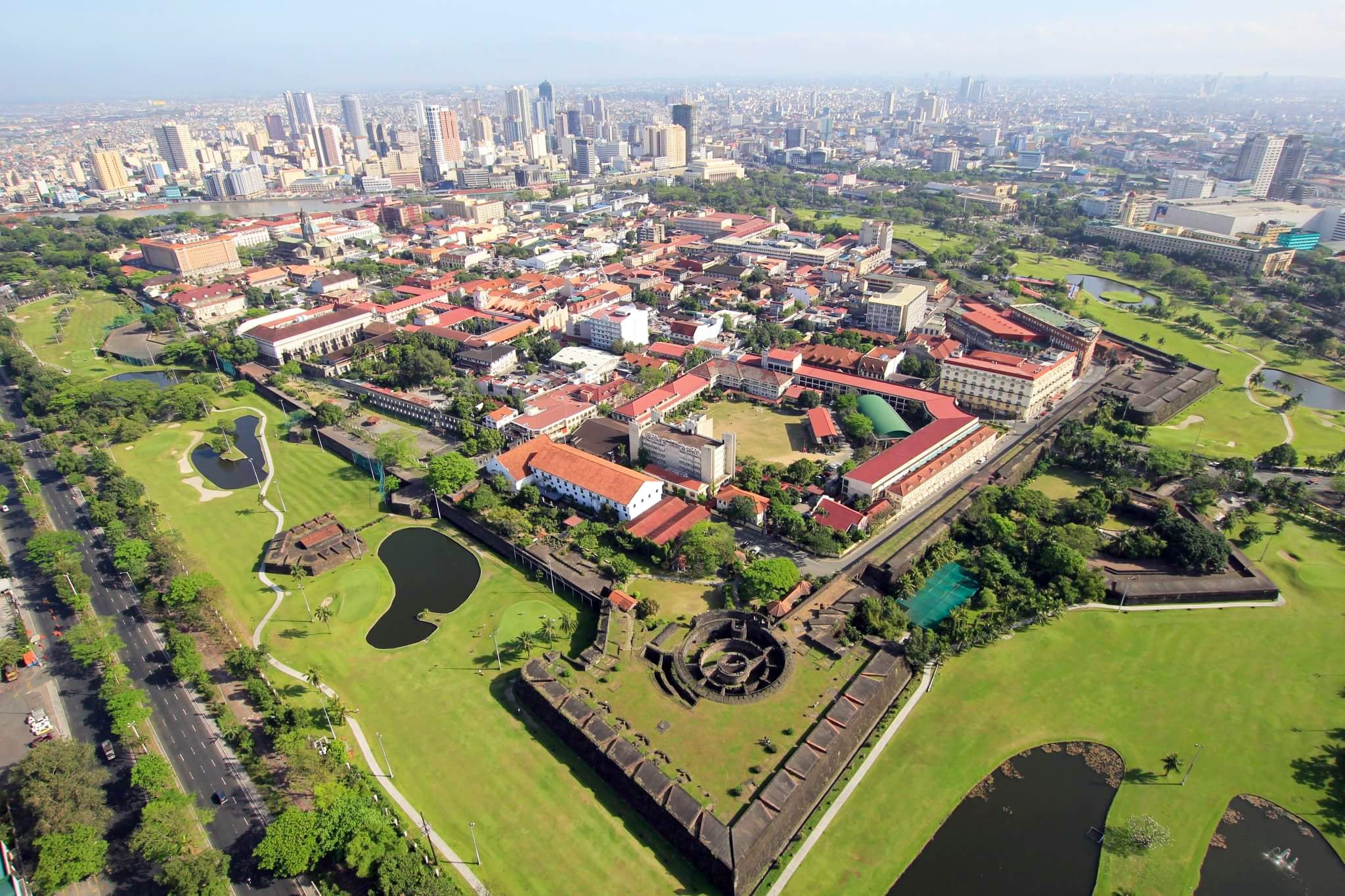
Intramuros is Manila’s original Spanish-era walled city and the densest concentration of colonial history in the capital. The Fort Santiago and Intramuros guide covers the fort itself, San Agustin Church (a separate UNESCO listing), and Casa Manila, a compressed, walkable version of 300 years of Spanish rule.
Most of the district is walkable, but it’s also exposed with limited shade, and the areas just outside the old walls are dense, traffic-heavy Manila, not an extension of the heritage setting; travelers picturing a European old-town stroll in both directions will find the transition abrupt. A hired guide or a bike tour (calesa or pedicab) makes more sense here than in most of the destinations on this list, given how much context is easy to walk straight past.
Sagada and the Cordillera: pre-colonial heritage that predates the Spanish entirely
Sagada, in Mountain Province, sits at high elevation in the Cordillera and holds a genuinely different category of heritage: the hanging coffins of the Igorot people, a burial practice that predates Spanish colonization by more than a thousand years and continues on a smaller scale today. This is not a photo-op curiosity; it’s an active cultural practice, and travelers should approach it with the same restraint they’d apply to any living cultural tradition. The nearby Banaue and Batad rice terraces, carved into the mountainside over roughly two thousand years and inscribed as a UNESCO World Heritage Site, are the more famous Cordillera landmark and worth combining into the same trip given the travel time north from Manila.
One practical detail that catches first-timers off guard: Sagada sits at high elevation, and nights get genuinely cold by tropical-country standards, often single digits Celsius, while most local guesthouses don’t run heating. Pack for it rather than assuming “Philippines” means warm after dark.
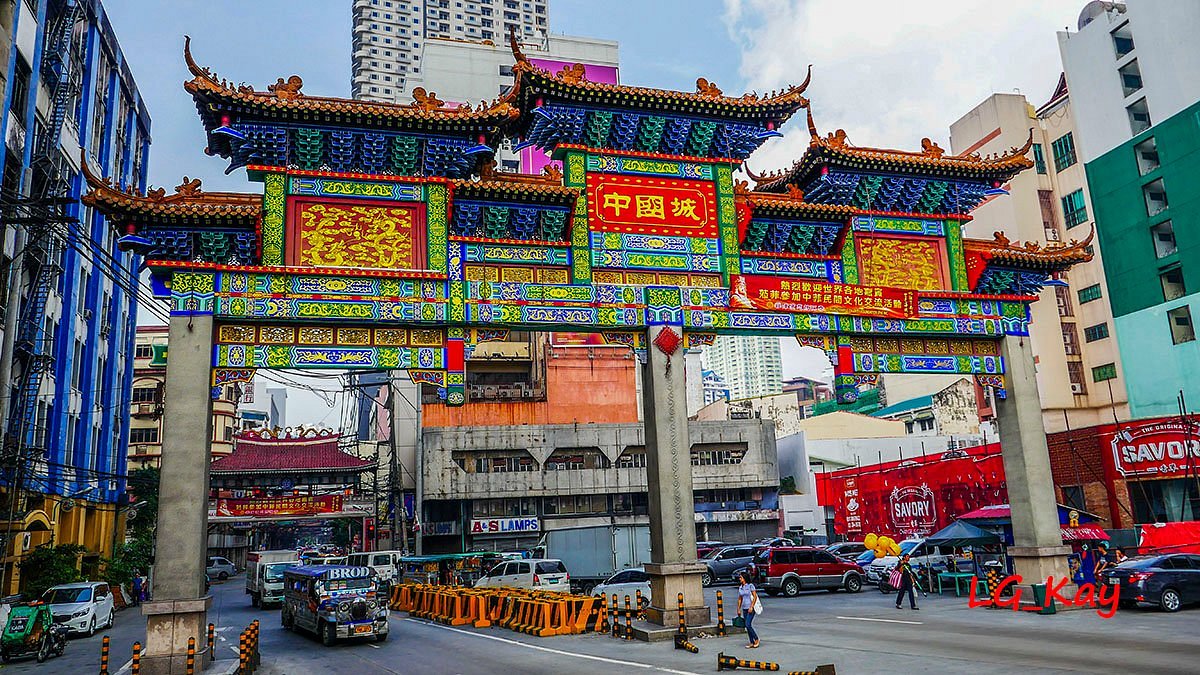
Binondo, Manila: the world's oldest continuously operating Chinatown
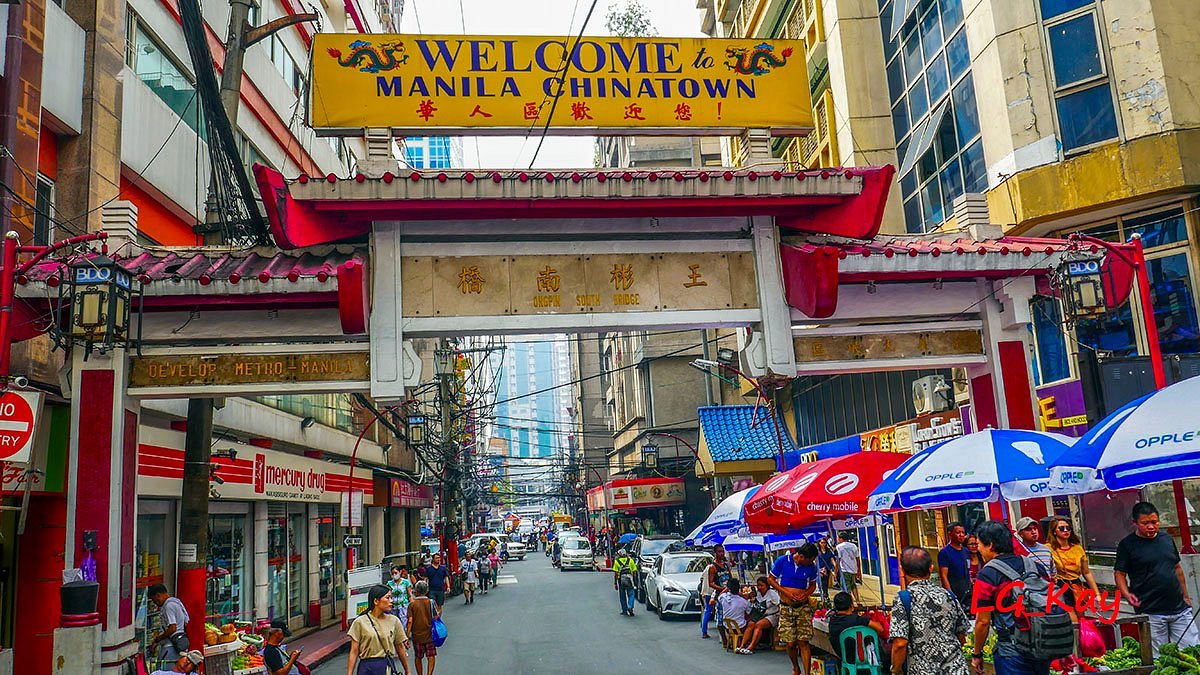
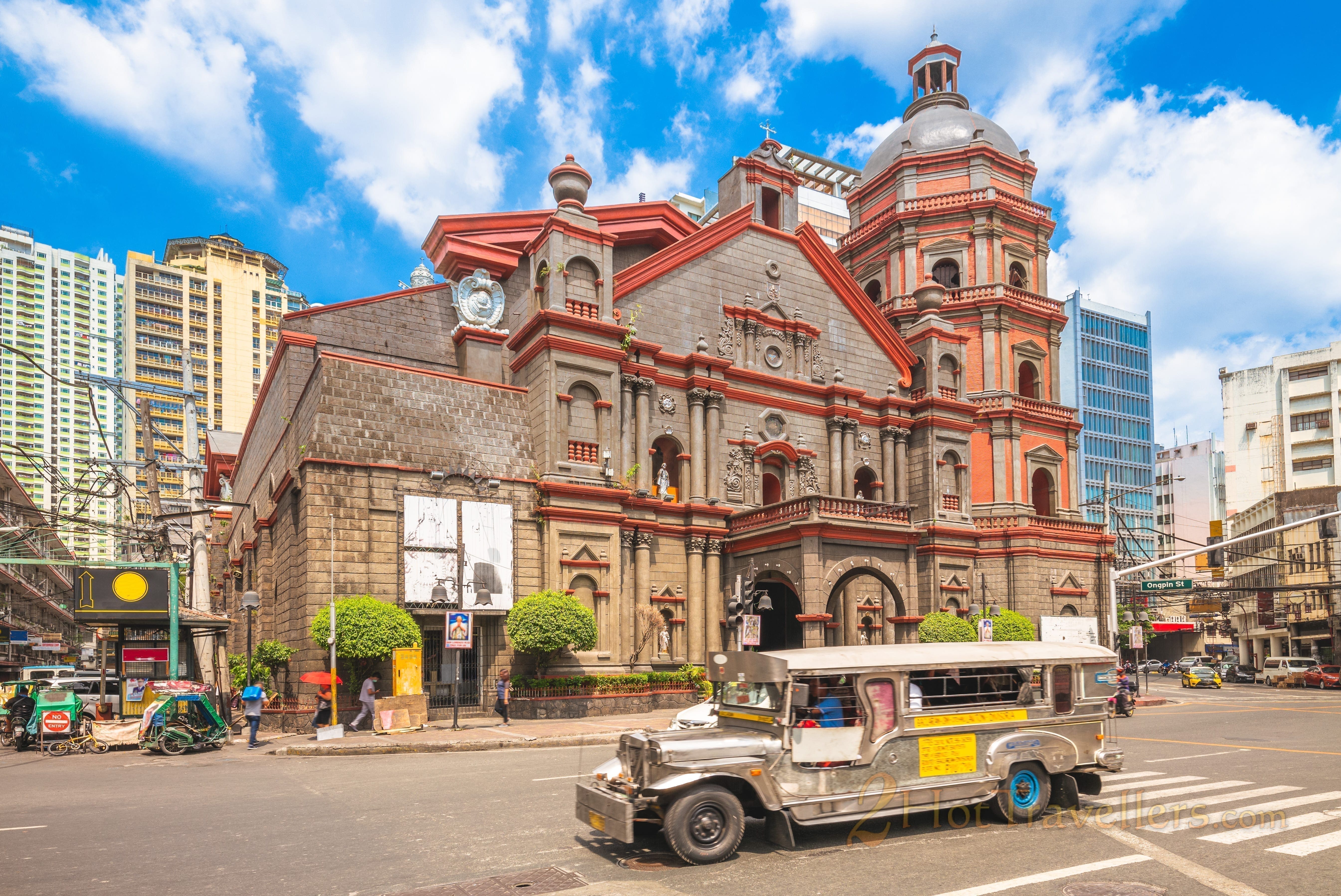
Binondo has functioned as a Chinese trading district since the 1590s, which makes it older than most of what gets marketed as a “historic Chinatown” globally. The area rewards a food-focused visit more than a sightseeing one: it’s dense, walkable in two to five hours depending on how far into San Nicolas and Divisoria you go, and built around commerce rather than curated attractions. That’s worth setting expectations around.
Binondo isn’t a preserved heritage district; it’s a working commercial neighborhood that happens to be centuries old, closer in feel to a busy market than a museum piece, and travelers wanting a quiet, photogenic old-town experience will find Vigan or Intramuros a better fit for that specific mood.
Mountain and Highland Escapes
Not every Philippines trip needs to be tropical. The country’s mountain regions offer a genuinely different climate and pace, and they’re consistently under-visited relative to the beach destinations, which says less about the mountains themselves and more about how the country gets marketed. Beach photography travels well online; a cool, overcast morning in the Cordillera doesn’t compress into the same kind of scroll-stopping image, so these regions lose the algorithm even when they win the actual experience.
There’s also a psychological shift worth naming: a beach trip is largely passive, arrive, adjust, absorb, while a mountain trip in this country tends to ask more of the traveler, longer drives, thinner infrastructure, weather that changes the plan without warning. That trade-off filters who shows up. Baguio, Batanes, and Tagaytay sit at three different points on that spectrum, from an easy first step into cooler air to a genuine commitment that rewards patience over convenience.
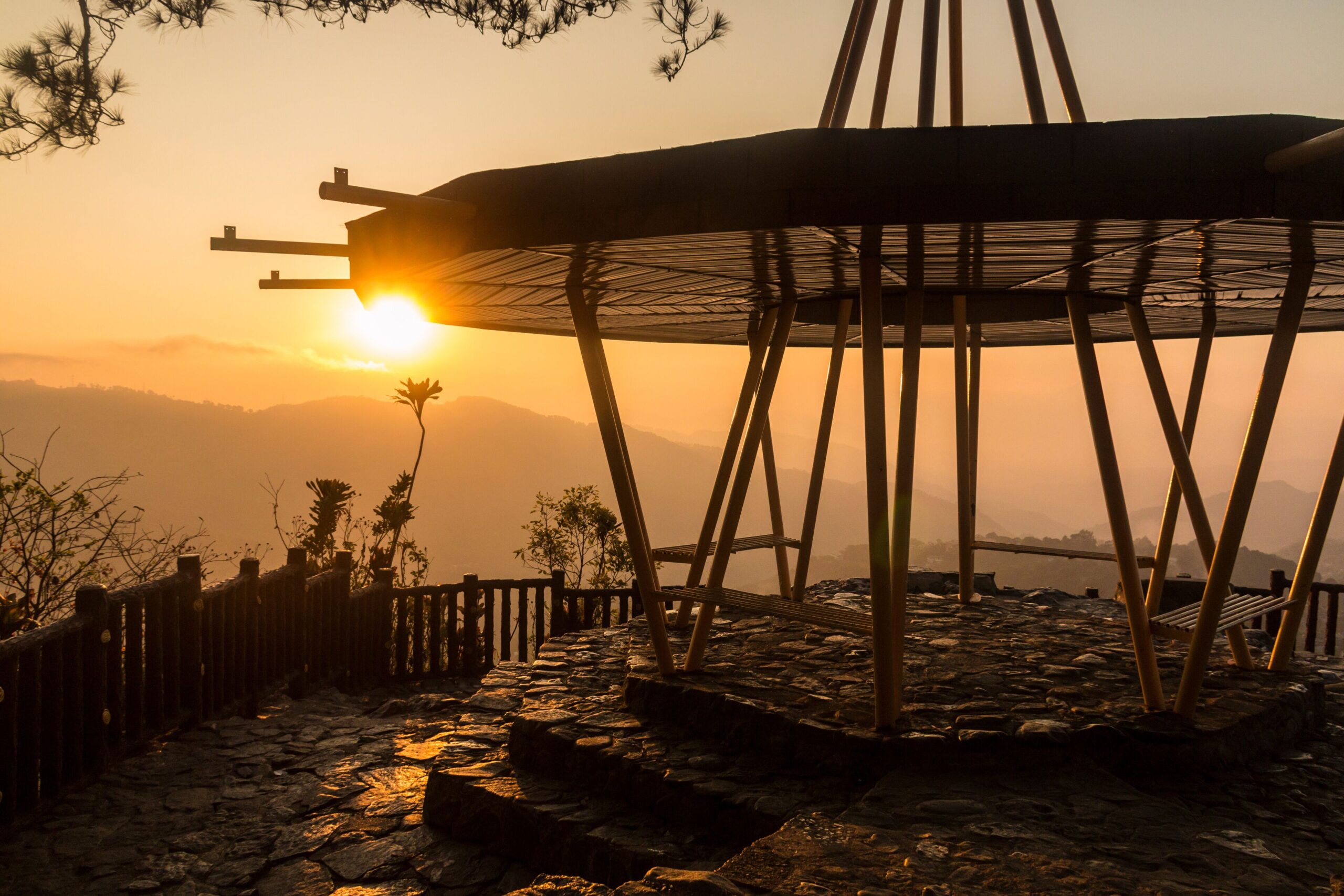
Baguio: the country's summer capital
Baguio, in the Cordillera foothills, was built up during the American colonial period specifically as a cool-climate retreat from Manila’s heat, and that function hasn’t changed. Camp John Hay, a former US military base turned leisure park, is the anchor attraction, offering pine forest trails, golf, and noticeably cooler air than almost anywhere else at this latitude.
It’s worth correcting the expectation some travelers arrive with: Baguio is cool by Philippine standards, typically in the high teens to low 20s Celsius, not the frost-and-fog mountain town its “Summer Capital” branding sometimes implies. Baguio works well as a first mountain trip: it’s a manageable 4 to 6 hour drive from Manila, has developed tourism infrastructure, and doesn’t require the logistics commitment of Batanes or Sagada.
Batanes: remote, weather-dependent, and worth the planning
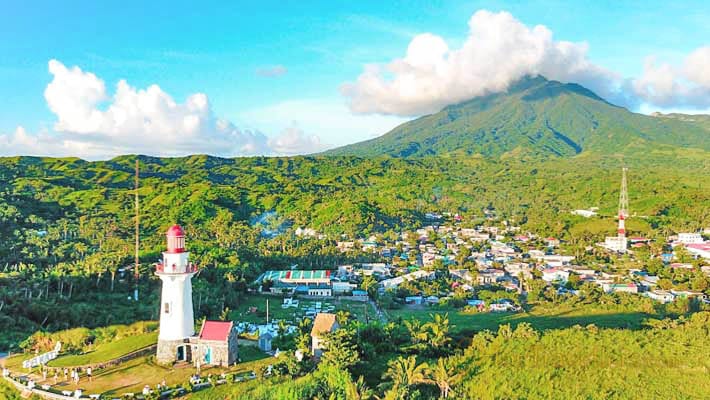
Batanes, the Philippines’ northernmost province, is a small cluster of islands (Itbayat, Batan, and Sabtang are the inhabited three) known for rolling hills, stone houses built to withstand typhoons, and a landscape that looks more like Scotland or New Zealand than anywhere else in the country.
The catch is real: inter-island transport runs on small boats across genuinely rough water, and flights out of Batanes get cancelled regularly due to weather, particularly outside the March to June dry season. This is not a destination to slot into a tight itinerary with a fixed return flight the next day. Batanes also photographs as a serene, empty landscape, and the images don’t convey the other side of that isolation: limited restaurant variety, patchy mobile signal outside Basco, and an evening routine that shuts down early. Travelers wanting nightlife or food variety alongside the scenery should treat this as a scenery-first trip, not a full-service one.

Tagaytay: the accessible highland day trip
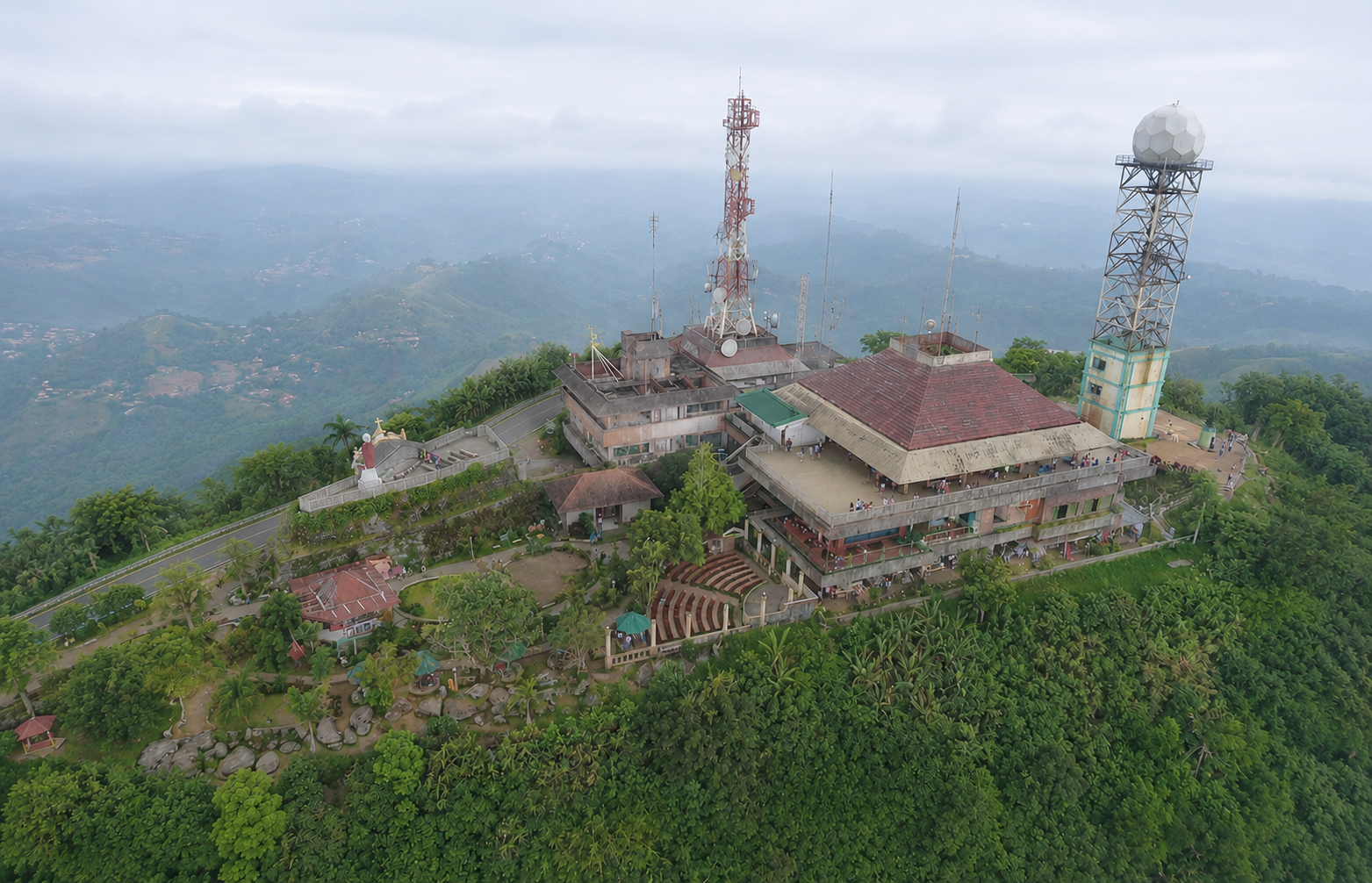
Tagaytay is the highland break that actually fits into a schedule. Close enough to Manila for a day trip, it delivers cooler air and a direct view of Taal Volcano, an active volcano sitting inside its own lake, without asking for the multi-day commitment Baguio or Sagada demand. The trade-off is the same proximity that makes it convenient: weekend traffic out of Manila turns a 90-minute drive into three hours each way, and the ridge-top restaurants built for the volcano view fill fast on Saturday and Sunday afternoons. Go on a weekday and it’s a different destination entirely.
Go on a weekday and it’s a different destination entirely. The Tagaytay Travel Guide covers the district breakdown and the best viewpoints for each.
Natural Landmarks and Geological Oddities
Some of the country’s most distinctive sights aren’t beaches, mountains, or heritage towns; they’re specific geological or ecological features worth a dedicated stop, and each one comes with a gap between how it photographs and what’s actually there on a given day. Chocolate Hills, La Paz Sand Dunes, and Kaparkan Falls all reward travelers who check the calendar before the map, since the version of each place circulating online usually captures a narrow seasonal window rather than a constant.
Chocolate Hills and the Bilar man-made forest, Bohol
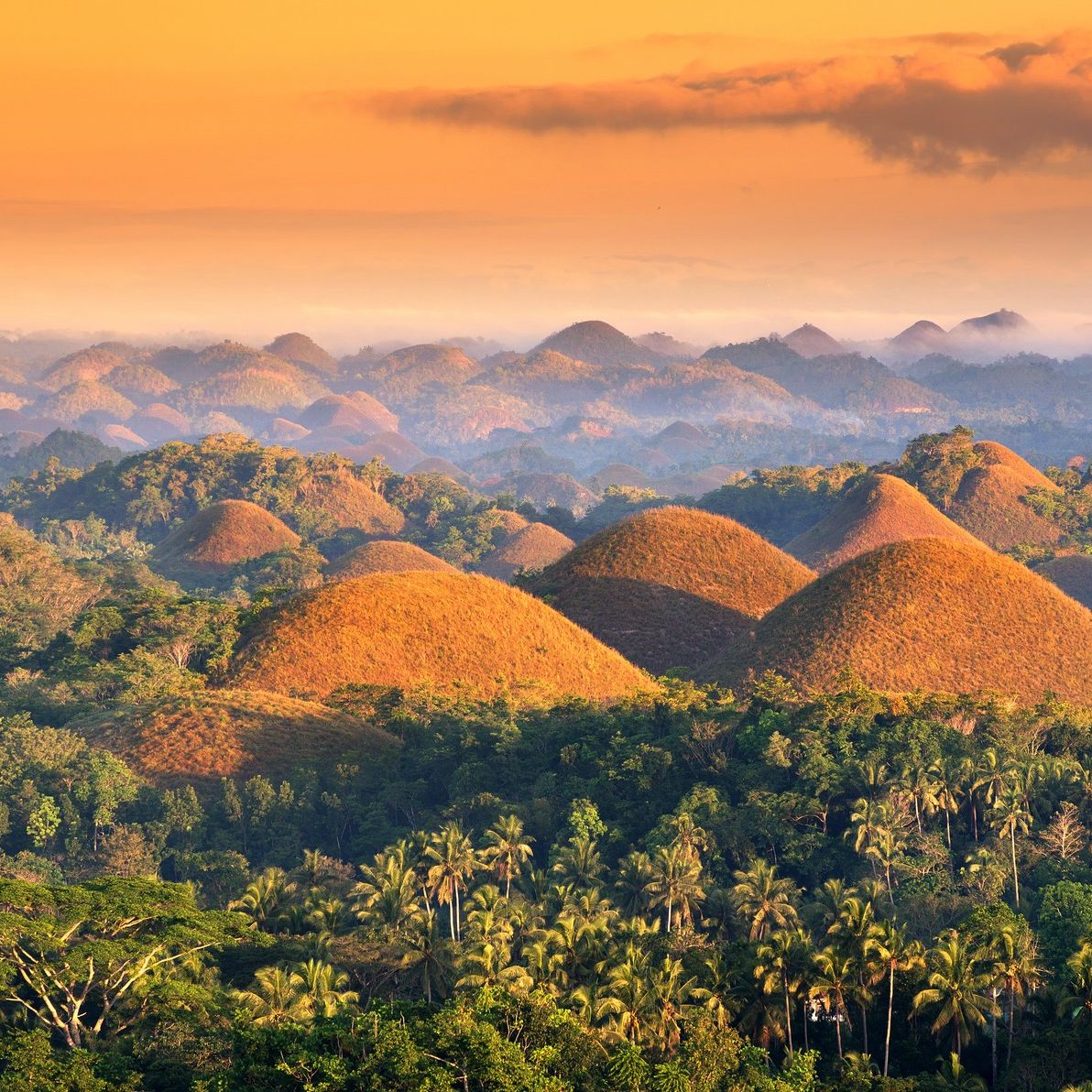
Bohol’s Chocolate Hills are more than 1,200 symmetrical, grass-covered mounds that turn brown in the dry season, giving them their name. That name is also the most common source of disappointment: visit during or shortly after rainy season and the hills are green, not brown, which surprises travelers who booked around the photos rather than the calendar. The color shift peaks around February to May. They’re a genuine geological anomaly with no fully agreed-upon explanation for their formation.
Nearby, the Bilar man-made forest is a dense two-kilometer stretch of mahogany trees planted in the mid-20th century, now tall and uniform enough that it reads as an entirely different, cooler microclimate within a five-minute drive. Both pair naturally with a Bohol countryside day trip that also covers the tarsier sanctuary, the Loboc River, and Alona Beach on Panglao Island, the beach base most visitors use for the Bohol leg.
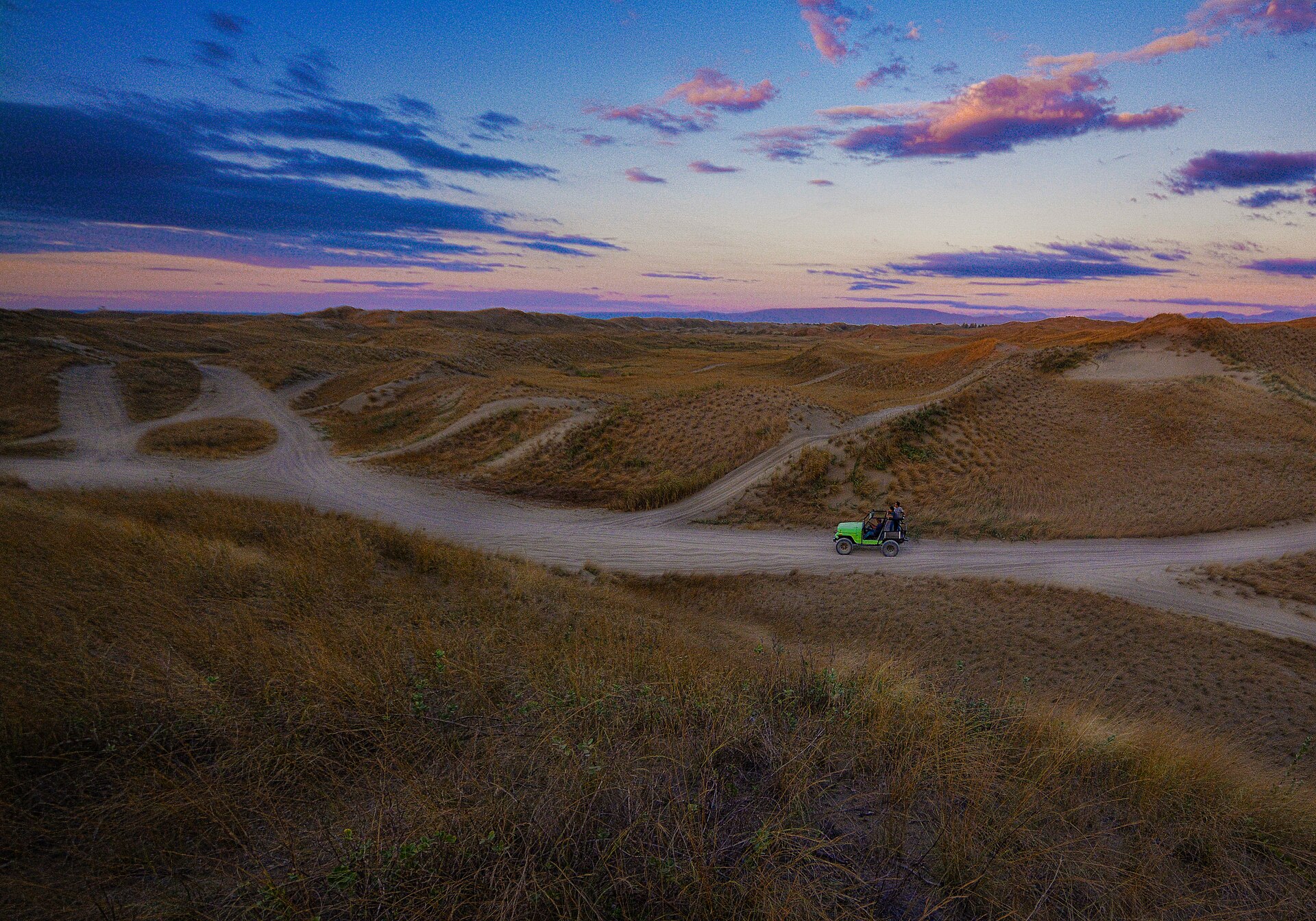
La Paz Sand Dunes, Ilocos Norte
The La Paz Sand Dunes cover roughly 85 square kilometers of coastal desert near Laoag City, an unexpected landscape in a tropical archipelago. Sandboarding and 4×4 tours are the main draw, and the dunes work well as an add-on to a Vigan or Ilocos heritage trip rather than a standalone destination, since Laoag is a manageable extension north. Set scale expectations correctly: this is a working coastal dune system, not a Sahara-style sea of sand, and the most photogenic sections are smaller than wide-angle shots suggest.
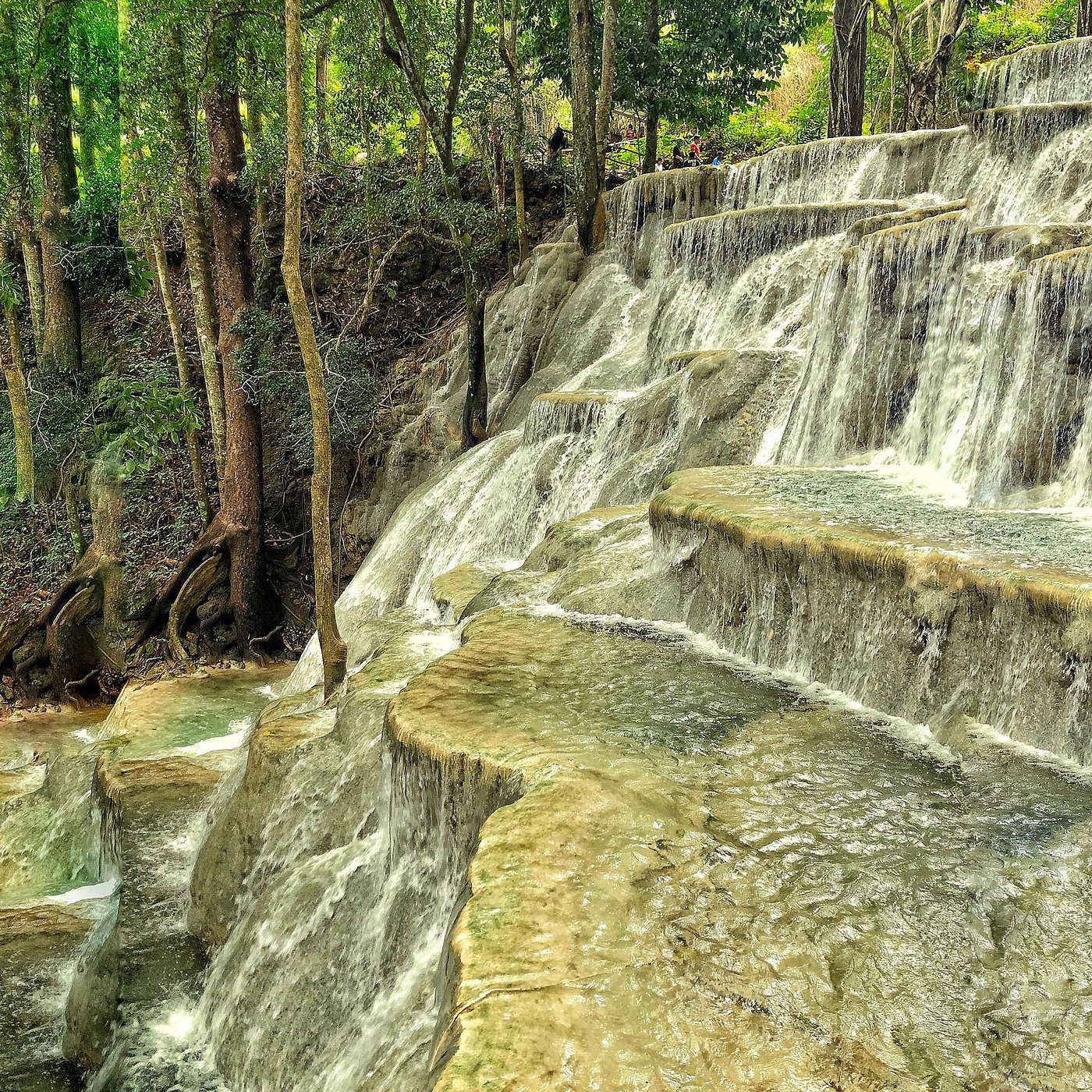
Kaparkan Falls, Abra
Kaparkan Falls, also known as Mulawin Falls, is a multi-tiered limestone cascade in the town of Tineg. It’s genuinely remote, best visited June to August when rainfall fills the terraced pools to their most vivid blue-green, and realistically only worth the trip if you’re already covering the northern Luzon heritage or mountain route. It is not an efficient standalone destination from Manila.
Most photos circulating online are taken in that narrow rainy-season window; visit outside it and the pools run noticeably lower and less saturated, which is worth knowing before building a trip around a specific image.
Cities: Where History, Commerce, and Modern Life Collide
City destinations in the Philippines tend to get undersold in favor of beach content, but Manila and Cebu both offer a density of things to do that beach towns simply can’t match. The two make a useful contrast: Manila carries the weight of the country’s full colonial and economic history packed into one sprawling capital, while Cebu functions as the calmer, better-positioned alternative hub for reaching the central islands.
Manila: layered, uneven, and worth more time than tourists give it
Manila rarely gets recommended as a destination in its own right, usually treated as a layover before flying to Palawan or Cebu. That undersells it, though it’s fair to be specific about why the reputation is mixed: Manila’s traffic is genuinely bad by international standards, districts are spread far enough apart that a single day can mean two hours in transit, and the city doesn’t reward aimless wandering the way Vigan or Intramuros do. Manila works better planned as three or four separate small trips stacked inside one city than as one continuous walk. It rewards travelers who pick two or three districts and treat them as separate outings rather than one continuous walk.
Beyond Intramuros and Binondo, Manila’s financial district Makati offers a modern counterpoint, with Greenbelt Park and the surrounding retail and dining corridor giving a clear look at the country’s other economic reality. Entertainment City in Parañaque, anchored by integrated resorts like City of Dreams, is the closest the country gets to a Las Vegas-style gaming and hotel strip, though it’s a narrower, more single-purpose visit than most travelers expect. The Port of Manila, one of the busiest seaports in Southeast Asia, is a useful visual reminder of just how central this city is to the country’s trade economy, even if it’s not a stop in itself.
Explore Further → Things to Do in Manila: Insider Guide to Attractions, History & Local Realities
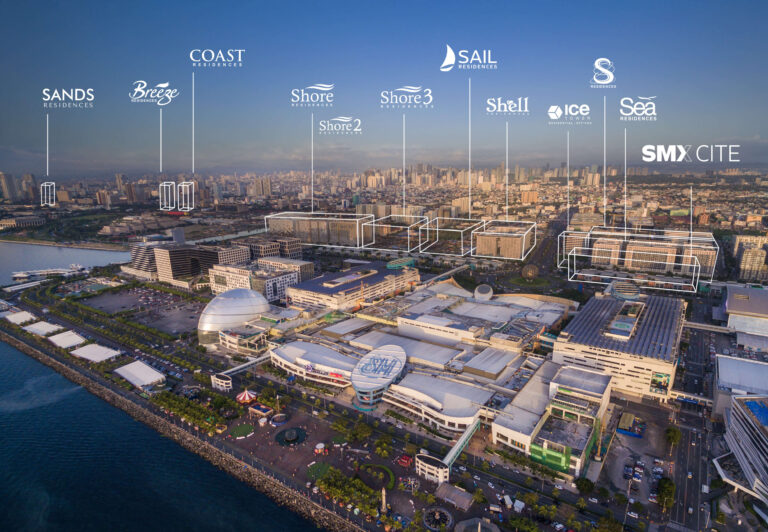
Cebu: the country's second city and a genuine alternative base
Cebu City functions as a real alternative hub to Manila, with better proximity to islands like Bohol, Malapascua, and Siquijor, and a food and heritage scene built around some of the oldest Spanish-era sites in the country, including the Basilica del Santo Niño.
Worth knowing before arrival: Cebu City itself is spread out and traffic-heavy in the same way Manila is, so travelers picturing a compact, walkable island base sometimes find the city portion less convenient than expected; the payoff is the fast, cheap island-hopping access once you’re through it. The Sirao Flower Farm in the Cebu highlands, planted with rows of celosia flowers, has become one of the province’s most photographed spots and works as a half-day add-on to a city stay rather than a full destination.

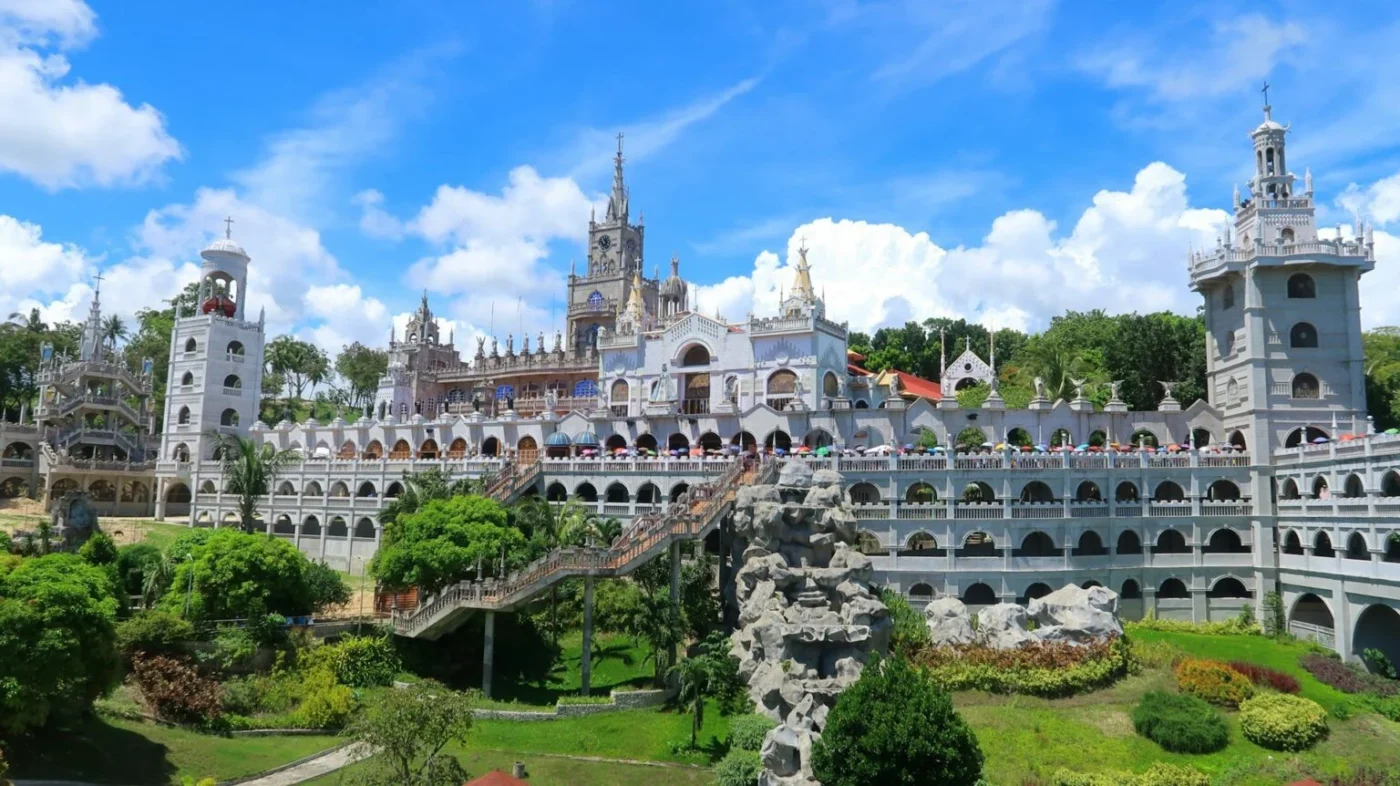
Hidden Gems: Places Most Itineraries Skip
These destinations don’t have the search volume of Boracay or Palawan, which is exactly why they’re worth flagging for travelers who’ve already done the standard route. Calauit, Fortune Island, Sitangkai, and the Valley of Colors all sit outside the usual itinerary logic for a different reason each: one is a managed wildlife sanctuary rather than a beach or ruin, one carries real physical risk, one is genuinely hard to reach, and one is worth naming mainly because nobody planned it.
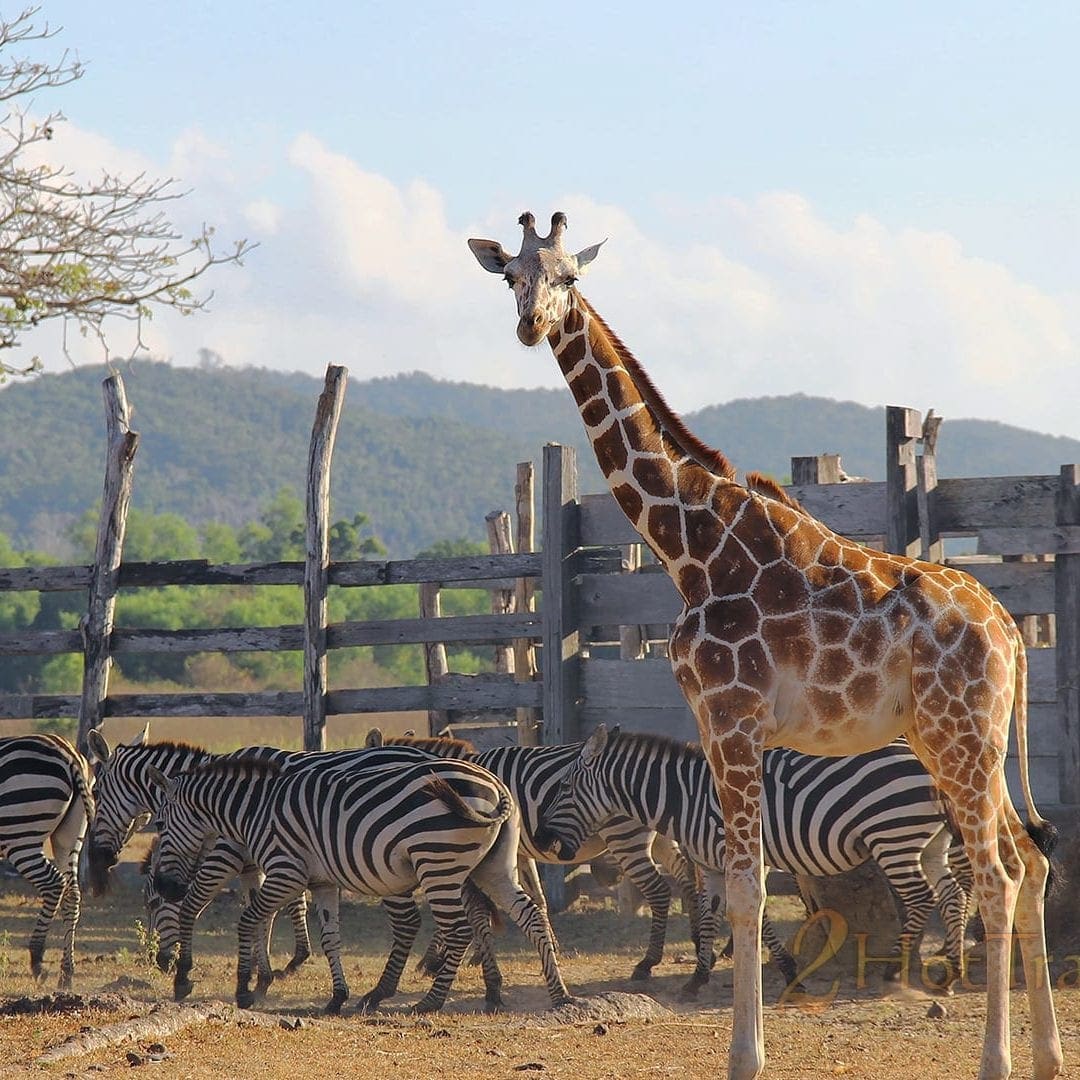
Calauit Safari Park, Coron
A 3,700-hectare wildlife sanctuary on Calauit Island in the Calamian Islands, Calauit is home to African species (giraffes, zebras, impala, and eland among them) introduced in the late 1970s and now established as a self-sustaining population several generations deep. Visits run as a guided vehicle safari along fixed routes through the grassland, typically two to three hours, and the island also holds a smaller population of native Philippine wildlife, including the Calamian deer, found nowhere else on earth.
Getting there means a boat crossing from Coron town followed by the safari itself, which makes it a genuine half-day commitment rather than a quick stop; most operators bundle it with other things to do in Coron rather than running it as a standalone trip. The framing to correct: this is a managed sanctuary with guided vehicle routes, not an open safari where animals roam unrestricted the way photos sometimes imply, and animal welfare standards have drawn scrutiny over the years, worth researching current conditions before booking if that matters to you.
Fortune Island, Batangas
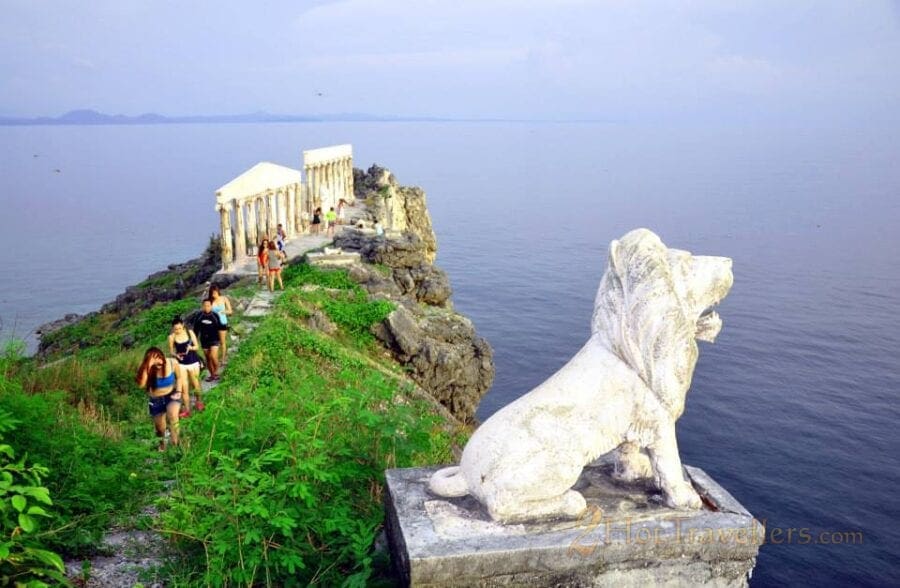
Fortune Island is a 27-hectare private island off Nasugbu with the ruins of a limestone Grecian-style structure built atop its cliffs decades ago and since left to weather naturally. There’s no electricity, minimal facilities, and cliff-diving spots that carry real risk without supervision on site, so this suits experienced, self-sufficient travelers more than a first-time group trip.
The ruins photograph beautifully in soft morning or late-afternoon light, which is when most of the circulating images are shot. There’s zero shade cover anywhere on the island, so the same shoot attempted closer to midday becomes a genuinely uncomfortable few hours rather than the minor inconvenience the photos suggest.

Sitangkai, Tawi-Tawi
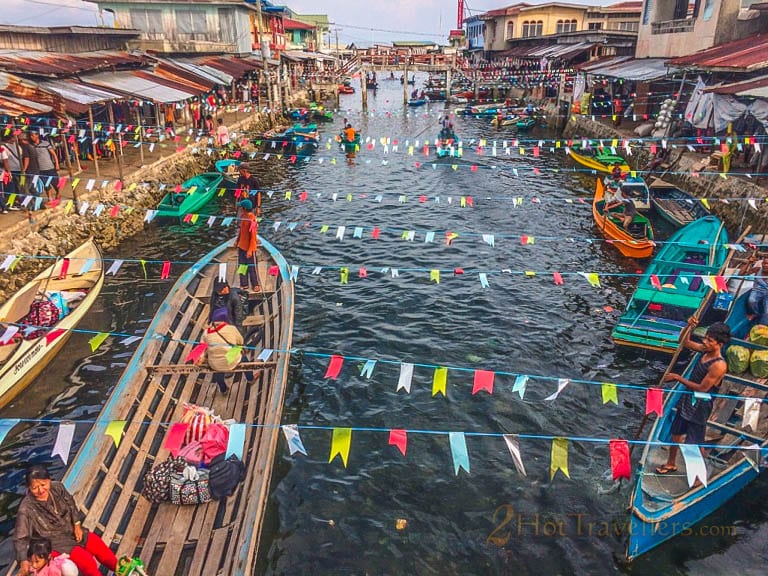
Sitangkai sits at the literal southern edge of the country, a municipality built almost entirely over water in Tawi-Tawi, closer to Borneo than to most of the Philippines it belongs to. Much of the town runs on stilts and coral-stone foundations, with footbridges linking house to house and boats doing the work a road network would elsewhere; that proximity to Malaysia also shows up in daily life, with cross-border trade and a visibly Sama population whose customs lean closer to Sabah than to Manila.
Getting there is a genuine undertaking: fly into Bongao’s Sanga-Sanga Airport from Manila, then take a ferry from Bongao pier via Sibutu Island, a half-day journey on top of the flight itself, and travel here typically requires coordinating with the local tourism office beforehand rather than showing up unannounced.
This is among the most logistically demanding destinations on this list, and it requires checking current DFA travel advisories for the Tawi-Tawi region before planning any trip. It earns a place here for a different reason than the beaches and heritage towns above it: it’s a useful corrective to the idea that “the Philippines” is one coherent travel product.
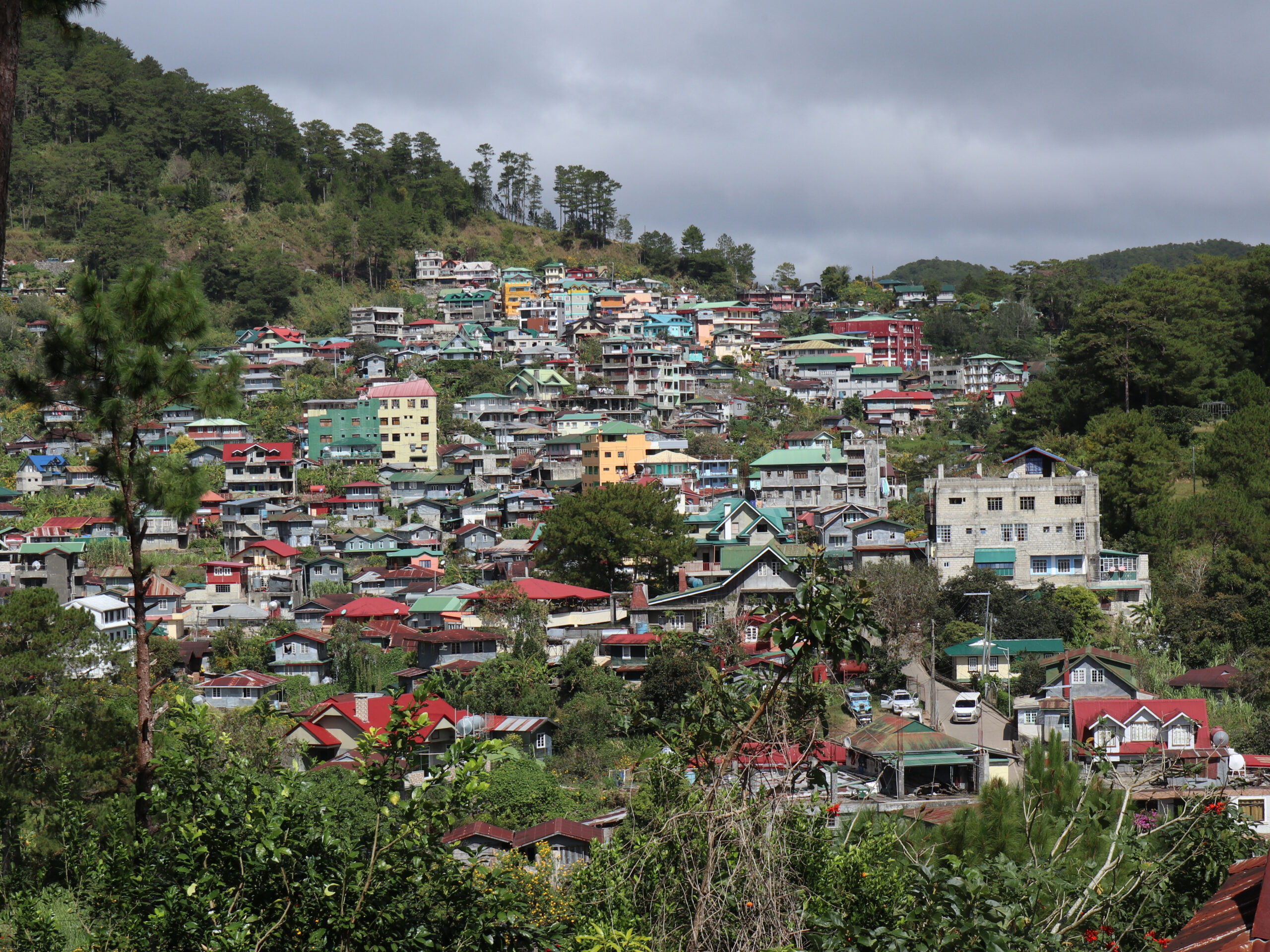
Valley of Colors, La Trinidad, Benguet
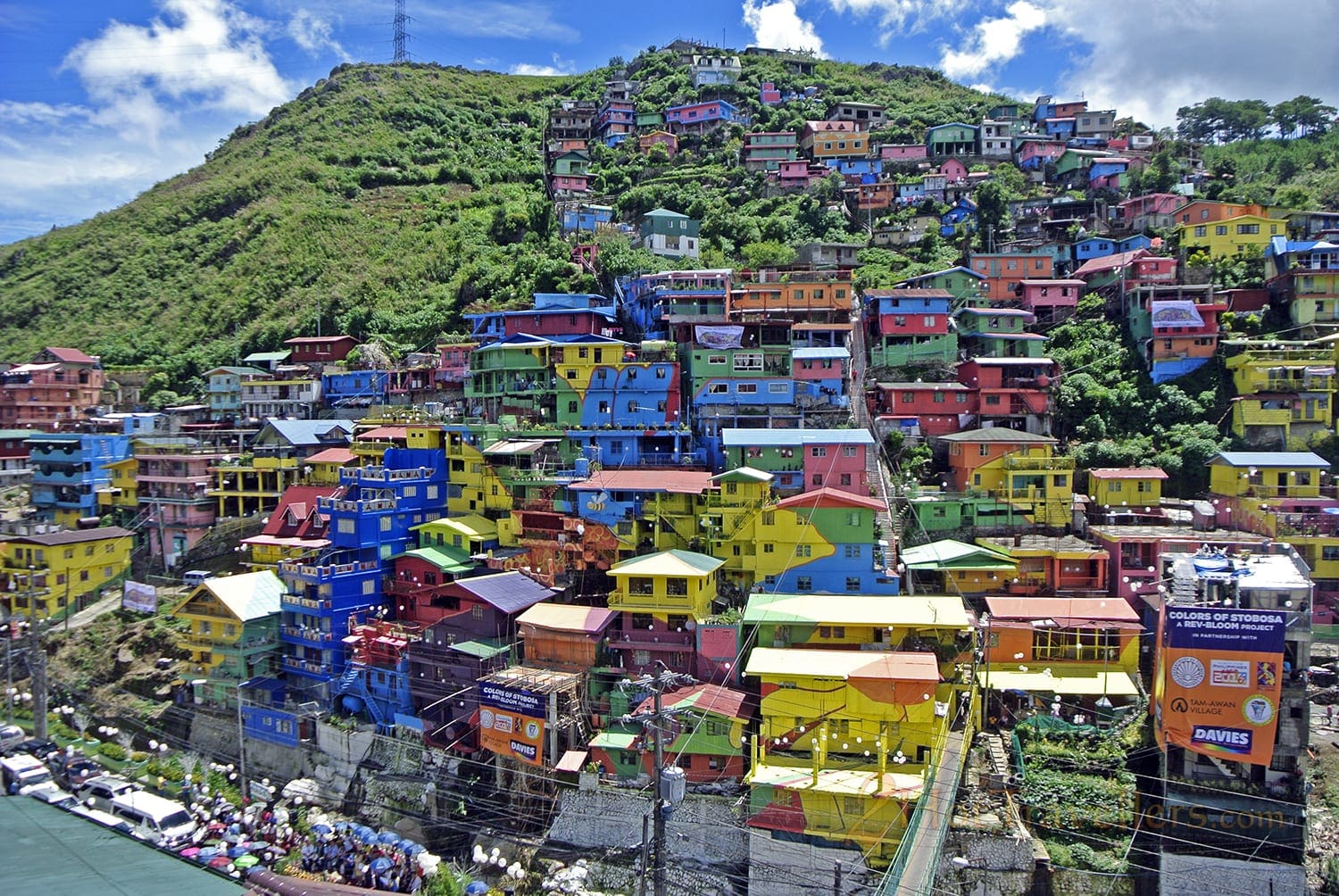
A short drive from Baguio, La Trinidad’s terraced hillside houses painted in bright, mismatched colors have become a minor detour destination for travelers already in the Cordillera. What sets it apart from a manufactured tourist installation is that the color scheme was never centrally designed; individual homeowners chose their own paint, at their own pace, which is why some houses look freshly done and others faded to almost pastel. It reads less like a curated attraction and more like an ordinary neighborhood that happened to photograph well, which is arguably the more honest version of the appeal. It’s a 30 to 45 minute stop rather than a dedicated day, best combined with a Baguio or Sagada route.
Matching a Destination to Your Travel Style
First-Time Visitor
7 to 14 days
One island region, one city. Pick Palawan or Cebu and Bohol, then pair it with three to four days in Manila for the historical and city coverage. Don't add a third region.
Beach Recovery
4 to 7 days
Minimal planning tolerance, maximum beach access. Boracay's infrastructure exists specifically to remove friction: reliable wifi, varied dining, an easy airport transfer.
Adventure & Surf
7 to 10 days
Siargao first, with Palawan as a strong second stop if time allows. Rainy season overlaps with surf season, so timing is a genuine trade-off, not a footnote.
Culture & Heritage
10 to 14 days
Vigan and the Ilocos region, combined with Sagada and Banaue in the Cordillera. More overland travel, less flying. Budget extra days for the road.
Off-Grid & Remote
7 to 10 days, flexible dates
Batanes or Sitangkai. Both regions are genuinely subject to weather delays, so build buffer days around any flight home. Not for a fixed itinerary.
City-Focused
5 to 8 days
Manila and Cebu, using Intramuros, Binondo, and Makati in Manila, plus the heritage district and Bohol day trips from Cebu. Minimal beach interest required.
Where to Go From Here
The Philippines rewards depth over breadth. A traveler who spends five focused days in Palawan will come away with a better trip than one who tries to touch six regions in the same window. Use the categories above to shortlist two or three destinations that actually match what you want from the trip, rather than defaulting to whatever has the most photos online.
Here’s the honest read on why this country is harder to market than Thailand or Indonesia, and why that’s not actually a weakness: it doesn’t hand you one clean brand. There’s no single “Philippines experience” the way there’s a Bali experience or a Bangkok experience, because the regions genuinely don’t resemble each other, culturally, geographically, or logistically. That’s inconvenient for a tourism campaign and useful for an actual traveler, since it means the country rewards someone who does the work of choosing rather than someone who just shows up expecting one archetype to hold true everywhere.
The fragmentation that makes this a harder country to sell is the same thing that makes it a better one to actually visit, provided you match the region to yourself instead of the other way around.
Once you’ve narrowed it down, the next step is turning a shortlist into a day-by-day plan. walks through how to sequence regions without losing full days to airports, and the destination guides linked throughout this piece cover the on-the-ground detail, where to stay, how to get around, what things actually cost, for each region above.
☕ If this article saved you a few hours of research, helped answer a lingering question, or made sense of something that wasn't entirely clear before, consider buying me a coffee. It helps keep the guides coming, the curiosity well caffeinated, and the occasional rabbit hole worth exploring.
Buy Me a Coffee ☕